Client case study · Back office and portals
ALBOUSH Elektrotechnik: website, customer portal and back office
One API serves a back office for DGUV V3 tests, an inspection portal, a customer portal and a 1,589-page website.
What did Datafalke build for ALBOUSH?
Datafalke built the website alboush-elektro.de and the software behind it for ALBOUSH Elektrotechnik, a master electrician’s business in Bottrop, Germany: a back office, a customer portal and a DGUV V3 inspection portal. DGUV V3 is Regulation 3 of the German Social Accident Insurance and covers testing electrical equipment. The website, back office and portals share one API and database.
- Back office: Quotes, orders and invoices as PDFs, invoices also as e-invoices, plus the dashboard, calendar and inspection jobs.
- Inspection portal: Device tests on a tablet with a separate login; readings typed in or imported from the tester as a CSV file.
- Customer portal: Password-free sign-in by link, quotes accepted or declined online, invoices as PDFs.
- Website: One page for each of the 31 services in each of the 36 towns, plus pages for neighborhoods and guides.
- For AI agents: A public MCP server answers four questions about the business and is read-only.
- pages in the alboush-elektro.de sitemap
- 1,589
- API endpoints
- 440
- data models
- 52
- back-office areas
- 36
Counted in the source code on November 23, 2026, code as of November 16, 2026.
ALBOUSH Elektrotechnik · counted live on November 22, 2026
What does the software look like?
ALBOUSH Elektrotechnik’s software connects the office, on-site testing and customers: the back office schedules appointments and inspection jobs, inspectors record readings in their own portal, and customers see quotes and invoices in the customer portal. To keep real data out of view, all screens come from a local installation with invented test data. The interface is in German.
DGUV V3 inspection jobs
The back office creates inspection jobs with site, reason and tester and assigns them; each job lists its devices with readings and results.
Numbering per year, four statuses, search by number, company, site or town, internal notes for the office only
Back office · DGUV V3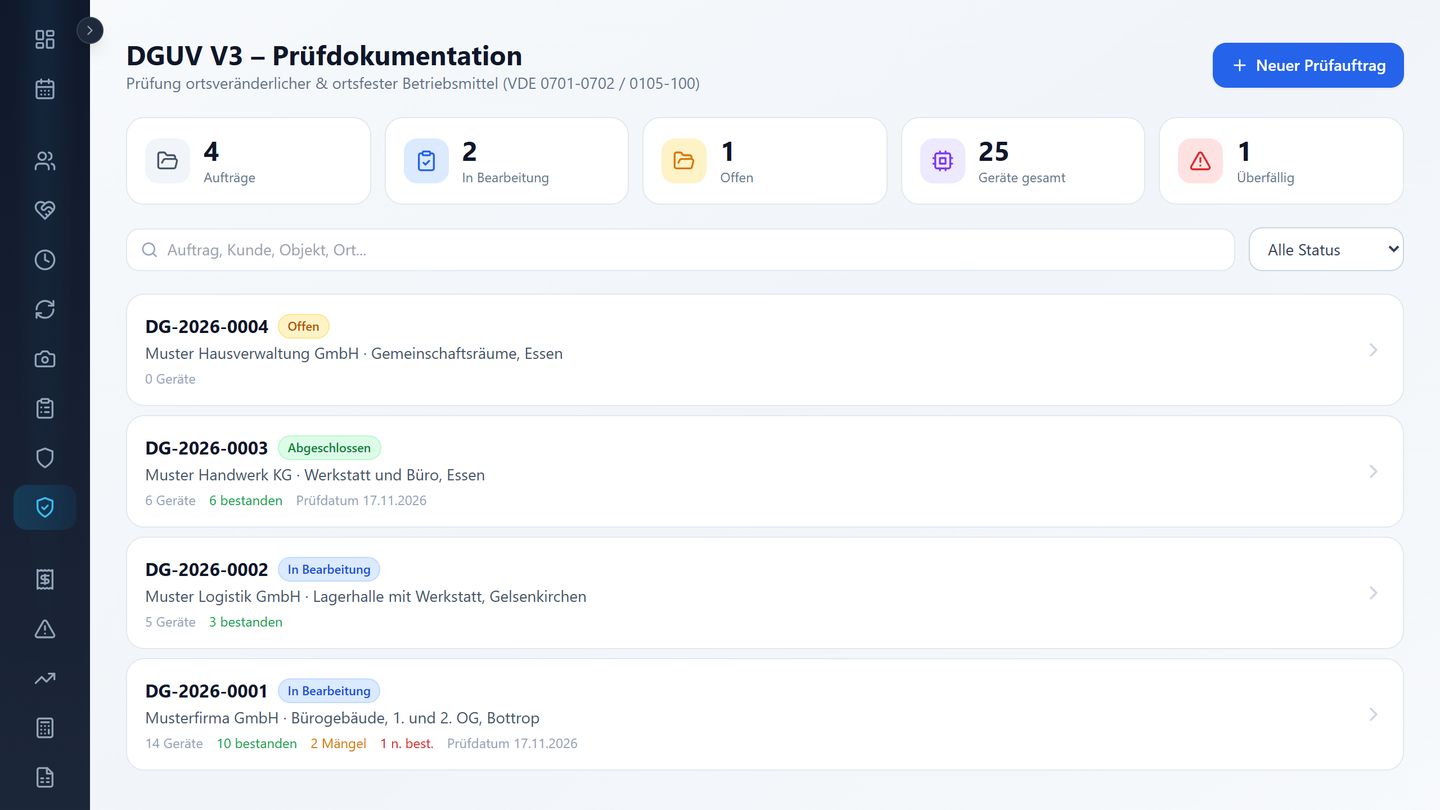
- The tiles count all jobs, jobs in progress, open jobs and all recorded devices.
- “Überfällig” (overdue) counts jobs whose next test date has passed.
- Search finds jobs by number, company, site or town; the filter narrows the list to one status.
- Each job shows the company, the site, the number of devices and their results: passed, with defects or failed.
Inspection portal
Inspectors work on a tablet with their own login, see only assigned and unclaimed jobs, and enter readings by hand or import them as a CSV file.
Limits per protection class, a suggested result, the next test date from the interval, a PDF test report
Inspection portal · Job on a tablet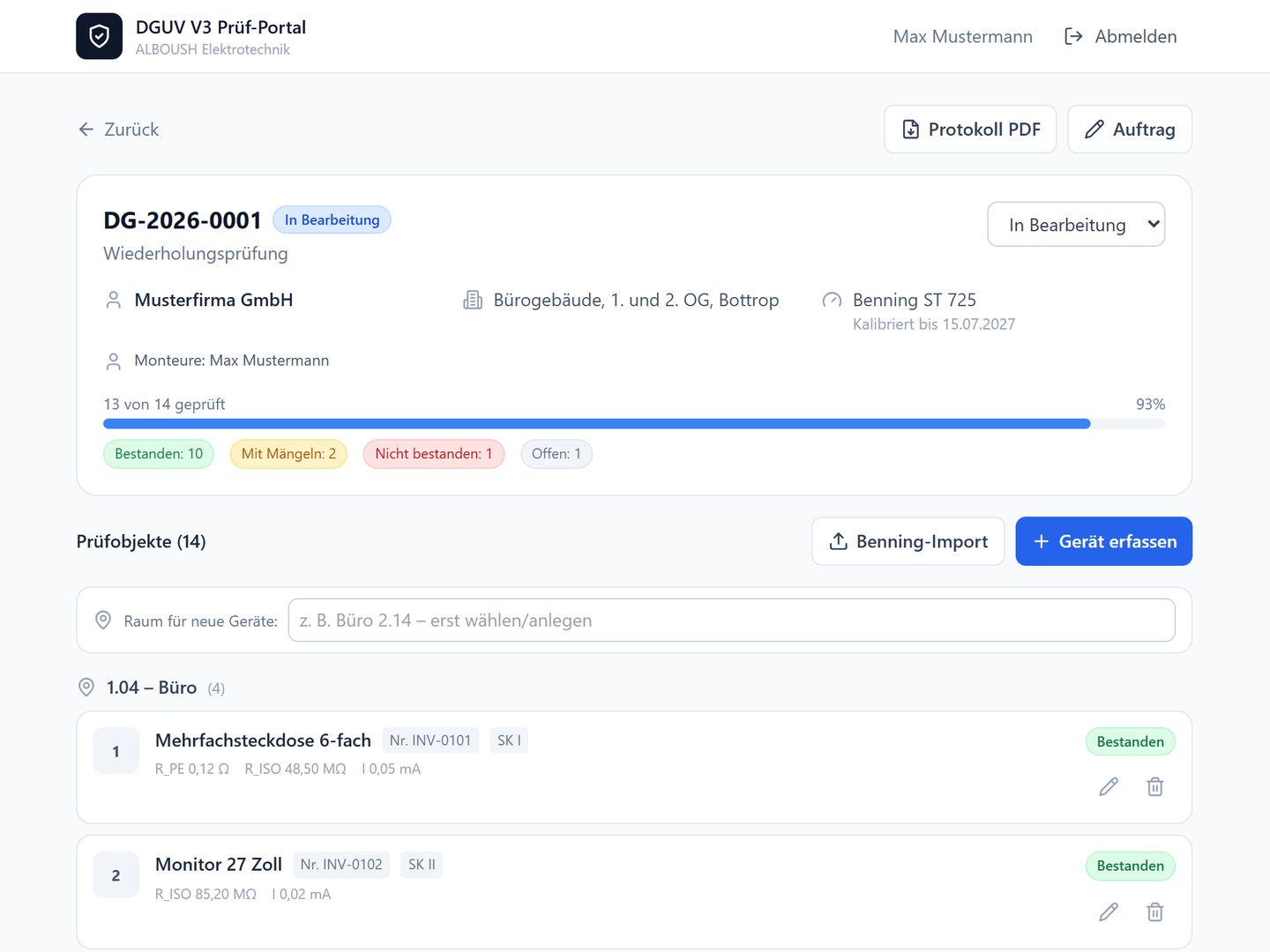
View with test data, captured on Nov 17, 2026 Password-free customer portal
Customers sign in with a link sent by email, see quotes, invoices and projects, and accept or decline quotes online.
Link valid for 15 minutes, draft invoices never shown, messages go to the back office
Customer portal · Sign-in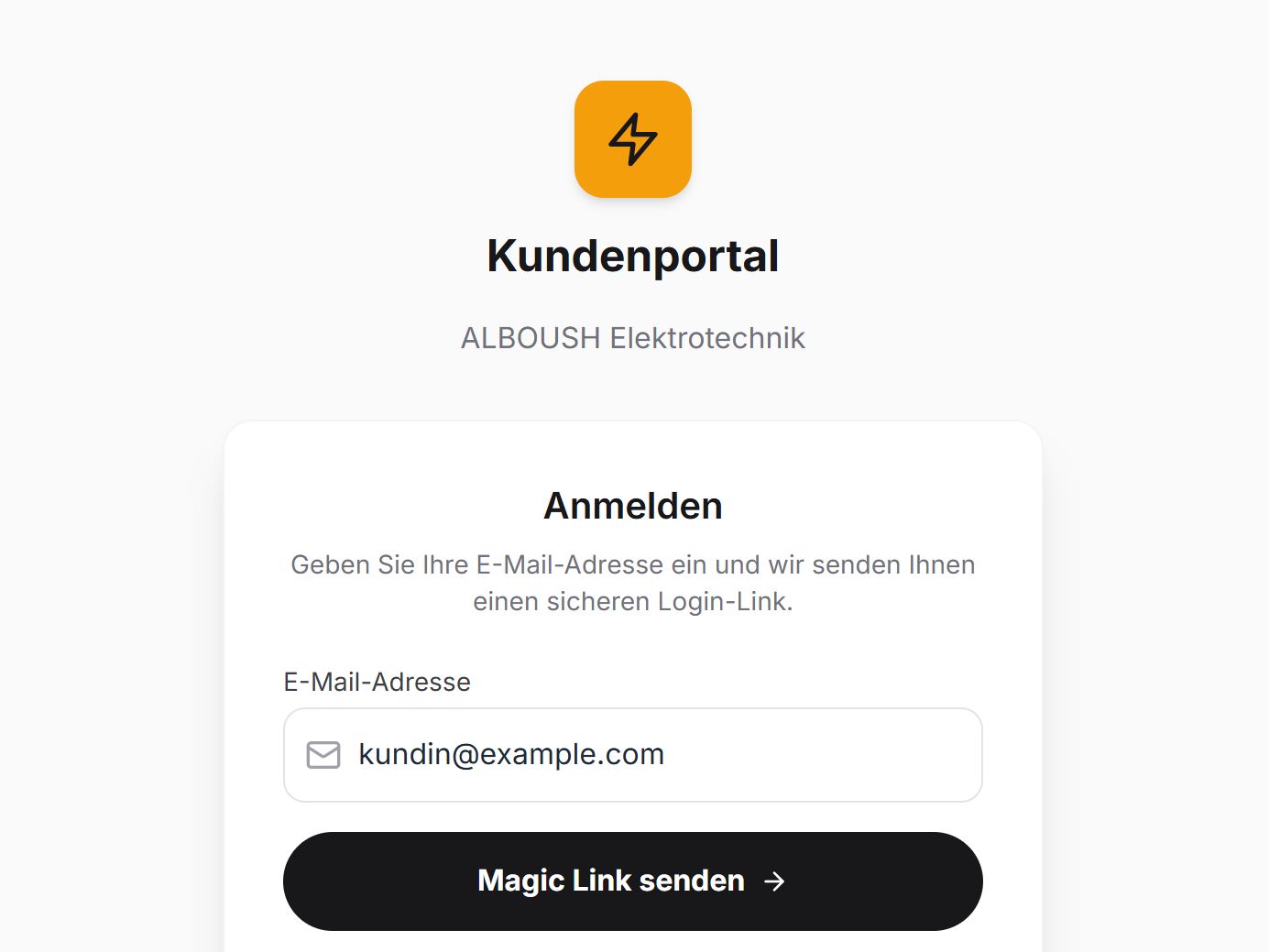
View with test data, captured on Nov 17, 2026 Calendar
The calendar is where jobs get scheduled; the month view shows up to two appointments a day with their time, color-coded by status.
Month view, list view and all appointments at a glance
Back office · Calendar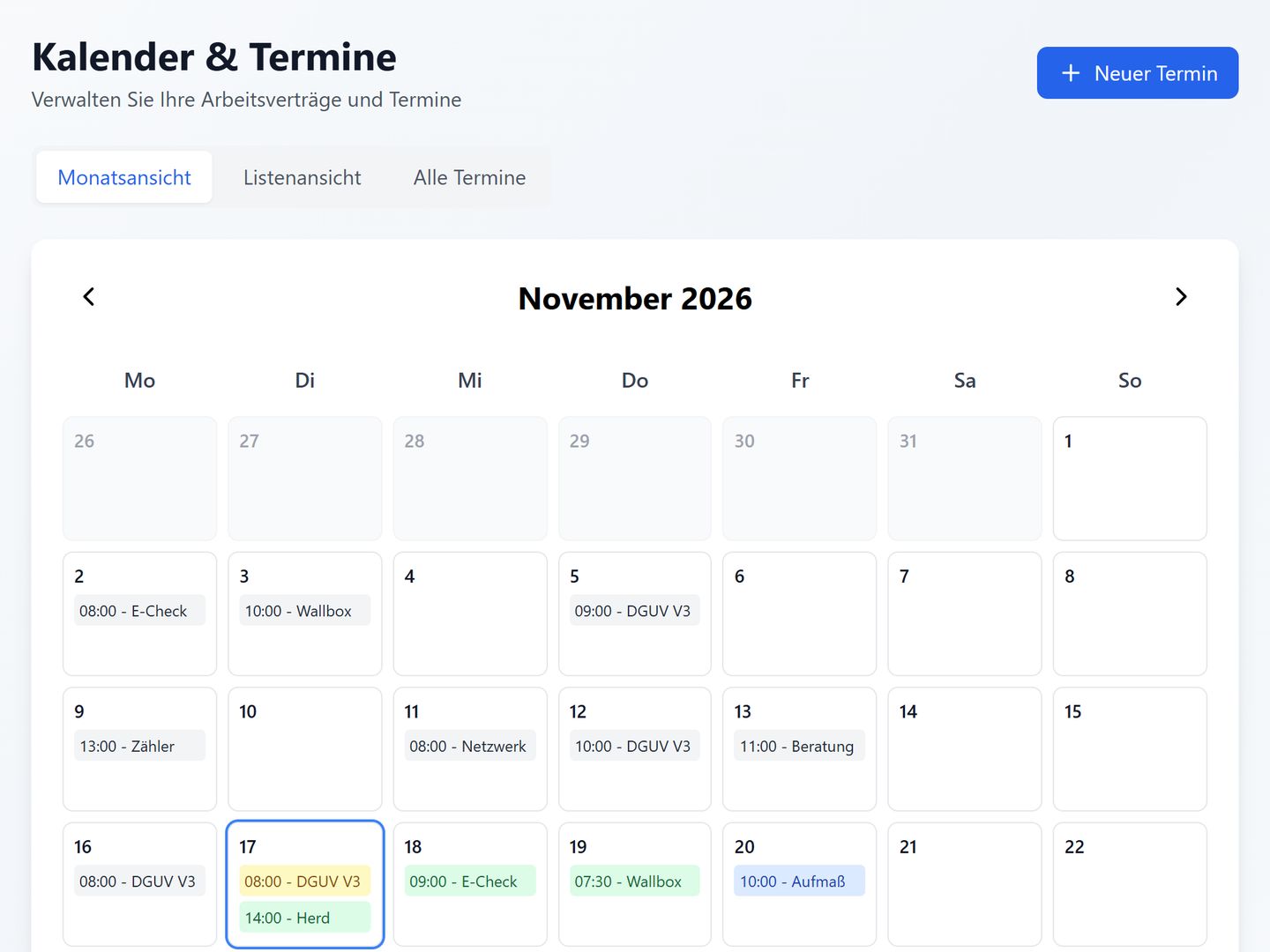
View with test data, captured on Nov 17, 2026 Dashboard, quotes and invoices
The dashboard counts customers, projects, orders, contact requests, blog posts and overdue invoices; quotes, orders and invoices come as PDFs.
ZUGFeRD e-invoices (EN 16931 profile), progress and final invoices, amounts accurate to the cent
Back office · Dashboard on a smartphone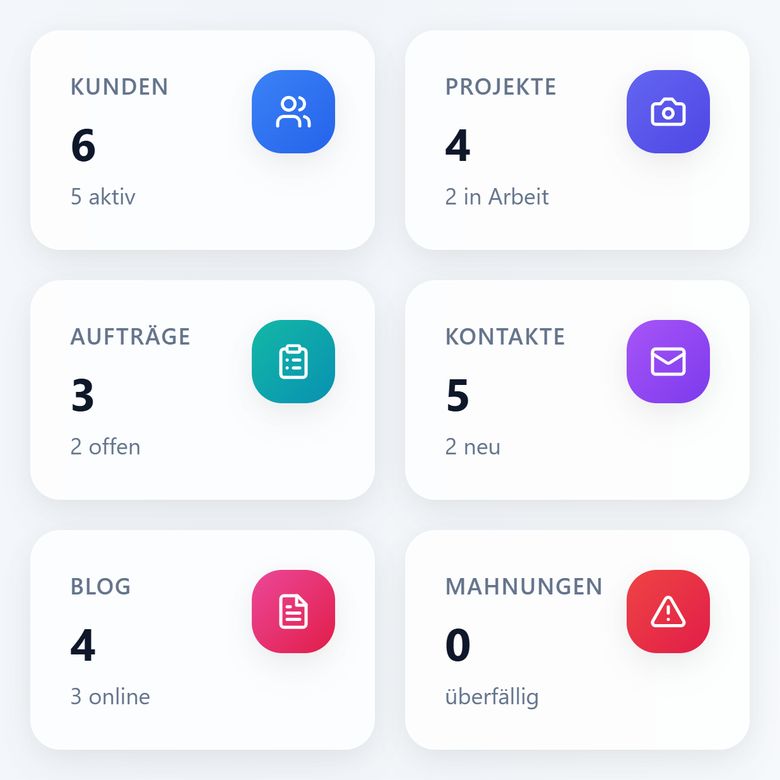
View with test data, captured on Nov 17, 2026 Interface for AI agents
A public Model Context Protocol (MCP) server answers four questions from AI agents: starting price, service area, business facts and next free slot.
JSON-RPC 2.0, read-only, with a public description for agents
Excerpt from the tools/list response, Nov 16, 2026, translated from German. It shows the four tools with their names from the code; the short descriptions are by Datafalke, without prices. Billing by direct debit
A separate billing system invoices recurring contracts when due, announces each SEPA direct debit in advance and collects it via Stripe.
Monthly, quarterly or yearly; cancellation instead of deletion, payment reminders in three stages, a change log
Flow shown with test data; steps based on the source code, as of Oct 2, 2026. A separate application with its own code and database. A switch decides whether debits start automatically; without it, the office triggers each one individually.
How do the parts fit together?
The website, back office, inspection portal and customer portal talk to the same API, which stores everything in one MongoDB database. Search and AI crawlers get finished HTML from the website server, and AI agents query the MCP server. Sign-in and role decide which data the back office and the two portals show.
- Website: HTML for crawlers
- Back office: Documents, inspections
- Inspection portal: Tablet and smartphone
- Customer portal: Sign-in by link
- MCP server for AI agents
- API: 440 API endpoints
- MongoDB: 52 data models
- Email delivery: Portal sign-in links
Decisions
- One API for every interface The back office, inspection portal and customer portal share the same data; customers never see draft invoices or internal fields.
- Finished HTML for crawlers People get the React application; search and AI crawlers get an HTML version with headings, text, navigation and structured data.
- Readings straight from the tester A CSV file from the Benning ST 725 adds or updates devices with the tester’s verdict, and a repeat import keeps the visual check, room and photos.
What was the starting point?
ALBOUSH Elektrotechnik is a master electrician’s business in Bottrop. By its own account, it works in 36 towns in North Rhine-Westphalia, from the Ruhr area to Cologne and Wuppertal. Its services range from adding a new outlet through E-Check safety tests and DGUV V3 inspections to installing EV chargers and rewiring older buildings.
People looking for an electrician search by service and town: an E-Check in Gelsenkirchen, for example, or an EV charger in Essen. They also ask AI assistants such as ChatGPT or Perplexity the same questions.
The office needed its own system for quotes, invoices and inspection records. The brief covered the website from concept to code, its preparation for search engines and AI assistants, and the software behind it: a customer portal, back-office software and a system for DGUV V3 inspections with its own sign-in for inspectors.
How is the system built and tested?
The website, back office and inspection portal are React applications, the API runs on Express and Node.js, the data sits in MongoDB, and the website, API and back office run on Railway. In a local test run on November 16, 2026, all 3,816 tests of the API and back office passed.
Layers
- User interfaces
- Website: React with an HTML version for crawlers
- Back office and inspection portal: React
- Customer portal inside the website
- Core
- API: Express on Node.js
- MCP server: JSON-RPC 2.0, read-only
- Scheduled jobs for email reminders and recurring invoices
- Data
- MongoDB, with documents and photos in the same database
- Operations
- Railway
- Other systems
- Billing: Next.js, PostgreSQL, direct debit via Stripe
Properties
- Customer portal
- Sign-in by link, valid for 15 minutes, single use
- E-invoice
- ZUGFeRD, EN 16931 profile, XML embedded in the PDF
- AI agents
- MCP server with four tools, read-only
- Scheduled jobs
- Due email reminders every 15 minutes, recurring invoices daily
- Machine-readable
- llms.txt, llms-full.txt, Markdown versions
- Billing
- monthly, quarterly or yearly; SEPA direct debit via Stripe after advance notice
Quality
- The tests check calculations, document wording and e-invoices, among other things.
- The API sets security headers with a Content Security Policy and HSTS, applies rate limits per area and imposes a lockout after repeated failed sign-ins.
What can be verified?
On November 16, 2026, we fetched all 1,589 URLs in the sitemap without JavaScript, using a crawler user agent. Each one returned status 200 and contained exactly one main heading, text and structured data; the median was about 8,000 characters of page text. We also fetched 20 URLs as GPTBot and as PerplexityBot and received the same HTML.
Ten of these URLs, including online tools and the careers and press pages, returned a generic page instead of their actual content, so 1,579 of the 1,589 URLs delivered their actual content.
In the first measurement on November 16, 2026, six pages had no main heading, including the FAQ and the blog overview. We fixed this the same day and measured again. We will publish figures on search, requests and AI assistant answers only with a baseline, period and source.
Results in numbers
1,579
of 1,589 pages with their actual content in the HTML for AI crawlers
Baseline 0 for GPTBot and PerplexityBot, until Aug 24, 2026, in our earlier version
Measured · all sitemap URLs without JavaScript, with a crawler user agent, 10 of them with a generic page
8,000
characters of text per page for AI crawlers, rounded median excluding the footer
Baseline about 1,100 characters, in our earlier version, measured Aug 24, 2026
Measured · same fetch, visible text counted; baseline from an internal log
These figures apply to this project and promise nothing for others.
How is the ALBOUSH website structured?
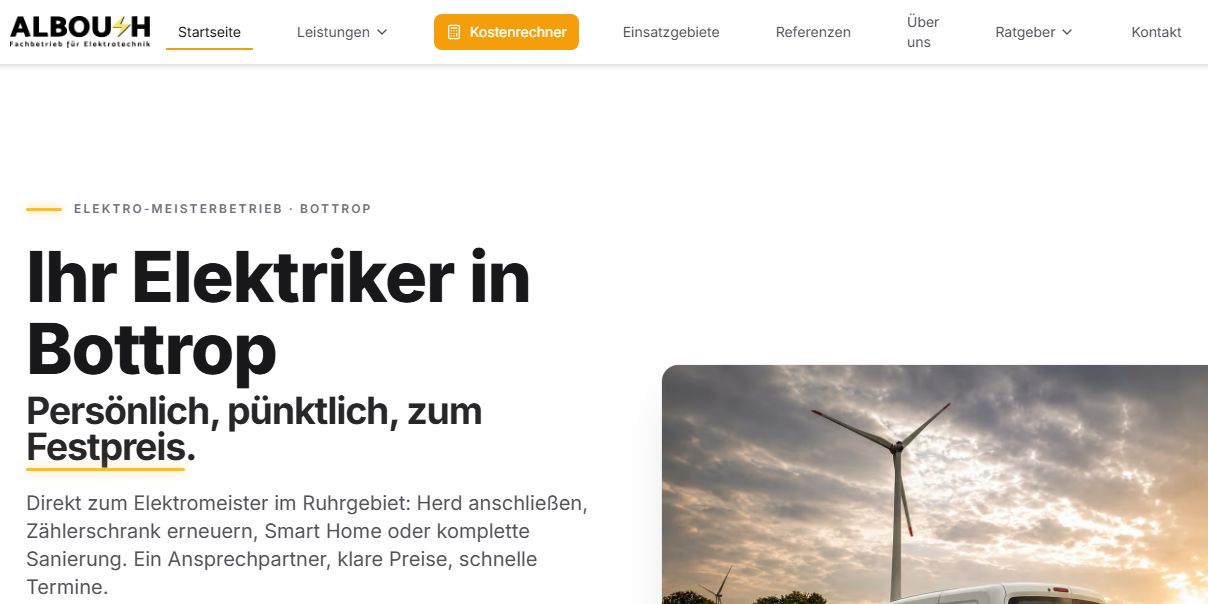
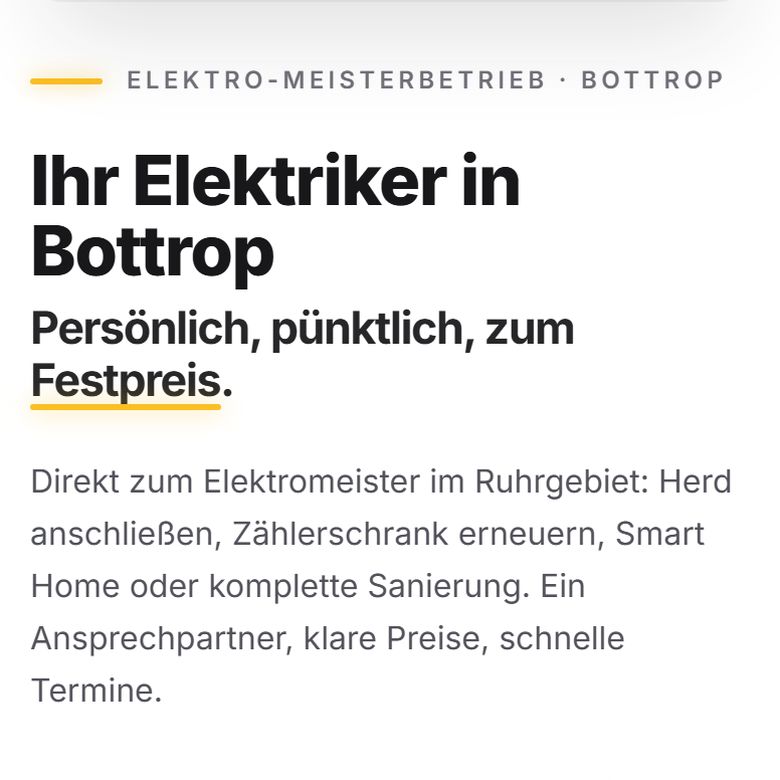
On November 22, 2026, the sitemap of alboush-elektro.de listed 1,589 pages: 31 service pages, 1,116 pages for each service in each of the 36 towns, pages for the towns and 267 neighborhoods, and 39 guides. An online cost calculator shows price estimates, appointments can be requested online, and a chat takes requests.
- For AI crawlers: In August 2026, we fixed a bug in our own earlier version. The crawler detection did not recognize GPTBot and PerplexityBot, so both got the same generic page at every URL. Since then, they have received the same HTML as search engines.
- For AI assistants: An API serves prices and the service area as data, and the service, town and guide pages also come as Markdown.

For trade businesses with many services and a large service area, we work out in a call which pages the area needs and which processes belong in software.
A system like this for your business
You’ll talk to the engineer who will build your project.
Project facts
- Project
- alboush-elektro.de with a customer portal, back-office software and a DGUV V3 inspection system
- Client
- ALBOUSH Elektrotechnik, master electrician’s business, Bottrop, Germany
- Timeframe
- Ongoing since November 2025
- Role
- Planning, design, development, SEO and GEO, customer portal and back-office software, hosting and ongoing development
- Services
- Website, search engine optimization, generative engine optimization (GEO), customer portal, back-office software
- Technology
- React and Express with a finished HTML version for search and AI crawlers, MongoDB, Railway; structured data, llms.txt and llms-full.txt, Markdown, MCP server
- Status
- Live; crawler readability measured on Nov 16, 2026
Results depend on the starting point and do not transfer to every project. Published with the consent of ALBOUSH Elektrotechnik.
More case studies
Editorial note
Researched and drafted with AI assistance. Mohammad Alboush has not yet checked the sources, figures and claims.
Content not yet reviewed
Changes to this report
Show all 6 changes
| Date | Type | Change |
|---|---|---|
| First publication | Version 1: website, customer portal, back office and DGUV V3 inspection system with two technical metrics, without search or request figures yet | |
| Update | Added test-data views of the back office’s dashboard, calendar and DGUV V3 area, the inspection portal and the customer portal, and a section on the software’s modules. | |
| Update | Rebuilt as a system page: added the flow of an inspection job, the architecture, technology and operations, and a chapter on the interface for AI agents; reorganized the text. | |
| Update | Added figures from the source code: API endpoints, data models and back-office areas, with the code version and the counting date. | |
| Correction | Cropped the screenshots for phones so their text is legible. Corrected the caption on the four tools: the short descriptions are by Datafalke. | |
| Update | Added a chapter on the separate billing system with SEPA direct debit, including the flow of a monthly invoice; technology and operations now list its stack. |
Spotted a mistake? Email us at kontakt@datafalke.de. We’ll fix it and log the change.