Client case study · Website and dashboard
RuhrTruck: encrypted request dashboard and website
A dashboard where requests arrive signed and stay encrypted, and a site that shows the emergency number on every page.
What did Datafalke build for RuhrTruck?
Datafalke built a dashboard and the website ruhrtruck.de for RuhrTruck, a tire and breakdown service for trucks and cars based in Herten, Germany. Contact form requests reach the dashboard signed and are stored encrypted field by field, and three roles share the work. Every page of the site shows the emergency number.
- Path of a request: the form hands over each request with a signature (HMAC-SHA256); name, contact and message are stored encrypted (AES-256-GCM).
- Dashboard: requests with four statuses, service reports that must be anonymized, the towns in the service area and the accounts.
- Three roles: dispatchers, editors and administrators see only their own areas, and only administrators publish.
- Website: pages for all 40 towns served; every page shows the emergency number and loads as finished HTML.
- For AI assistants: llms.txt, llms-full.txt, facts.json and Markdown versions; structured data as one record per page.
- pages in the sitemap of ruhrtruck.de
- 203
- endpoints
- 40
- tables
- 24
- test cases in the code
- 677
Counted in the source code on November 23, 2026, code as of November 16, 2026.
The code is newer than the live site, so details there may differ.
RuhrTruck · counted live on November 22, 2026
What does the dashboard look like?
RuhrTruck’s dashboard has been live since October 15, 2026, and shows the requests from the contact form, the service reports and the towns in the service area. Each of its three roles sees only its own areas. To keep real data out of view, all screens come from a local installation with invented test data. The interface is in German.
Signed, encrypted requests
The contact form signs each request it hands to the dashboard; name, contact and message are encrypted field by field, and each request has a status.
Timestamped signatures that expire quickly, no duplicate records, filters by status, newest request on top
Dashboard · Requests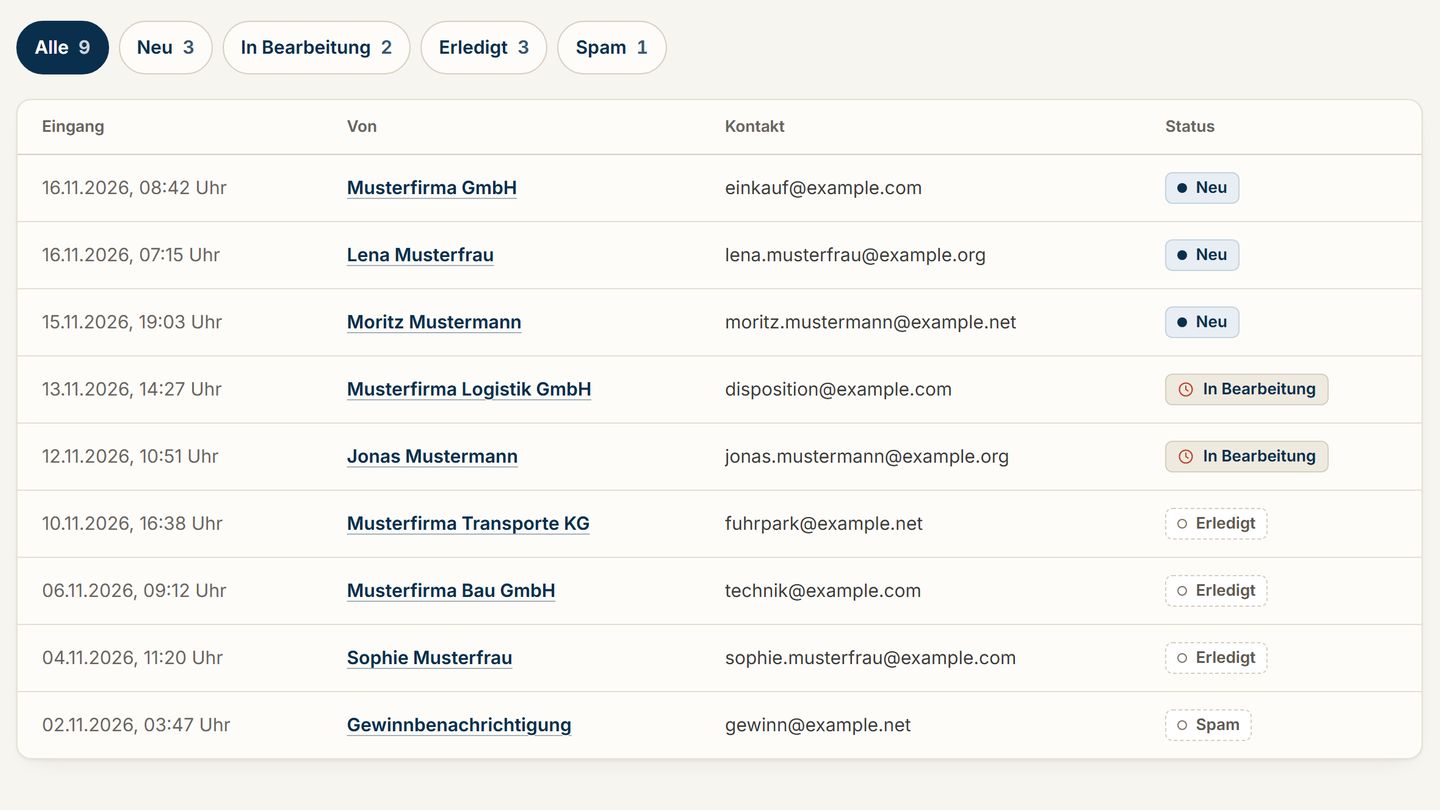
- The status filters count the requests: “Neu,” “In Bearbeitung,” “Erledigt” and “Spam” (new, in progress, done, spam).
- Each request arrives signed from the contact form; name, contact details and message are stored encrypted (AES-256-GCM).
- Each request carries its status; in the detail view, a new status is saved right away.
- The newest request is at the top, with received time, sender, contact and status.
Status and deletion on request
One click sets the status, and if the person asks, the request can be deleted from the database after a confirmation.
Provided for in the system: deletion after twelve months and a daily backup of all tables in the EU
Dashboard · Request details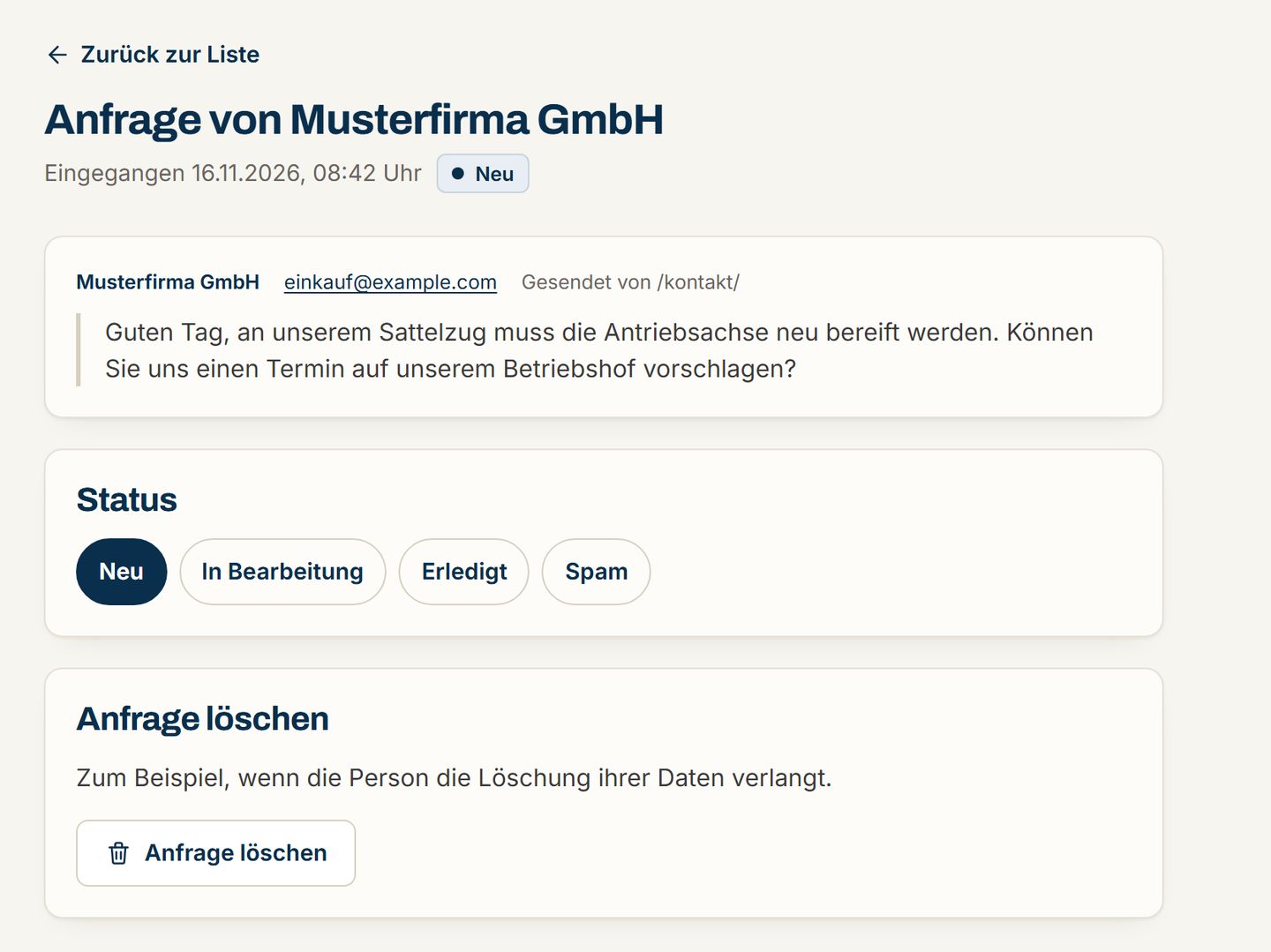
View with test data, captured on Nov 16, 2026 Sign-in and write protection
Sign-in checks hashed passwords and locks after failed attempts; writes need the same domain (same origin) and a token tied to the account.
Password hashing (bcrypt), HttpOnly session cookie, protection against forged writes (CSRF), browser rules (CSP)
- Session
- HttpOnly cookie with a signed token
- API
- security headers on every response, including HSTS
- Dashboard
- inline scripts only with a known hash (CSP)
Roles and accounts
Dispatchers see requests, editors see content and administrators also see accounts; only administrators decide whether a town is published.
Initial password shown once, deactivation signs out everywhere, the last active admin stays protected
Dashboard · Users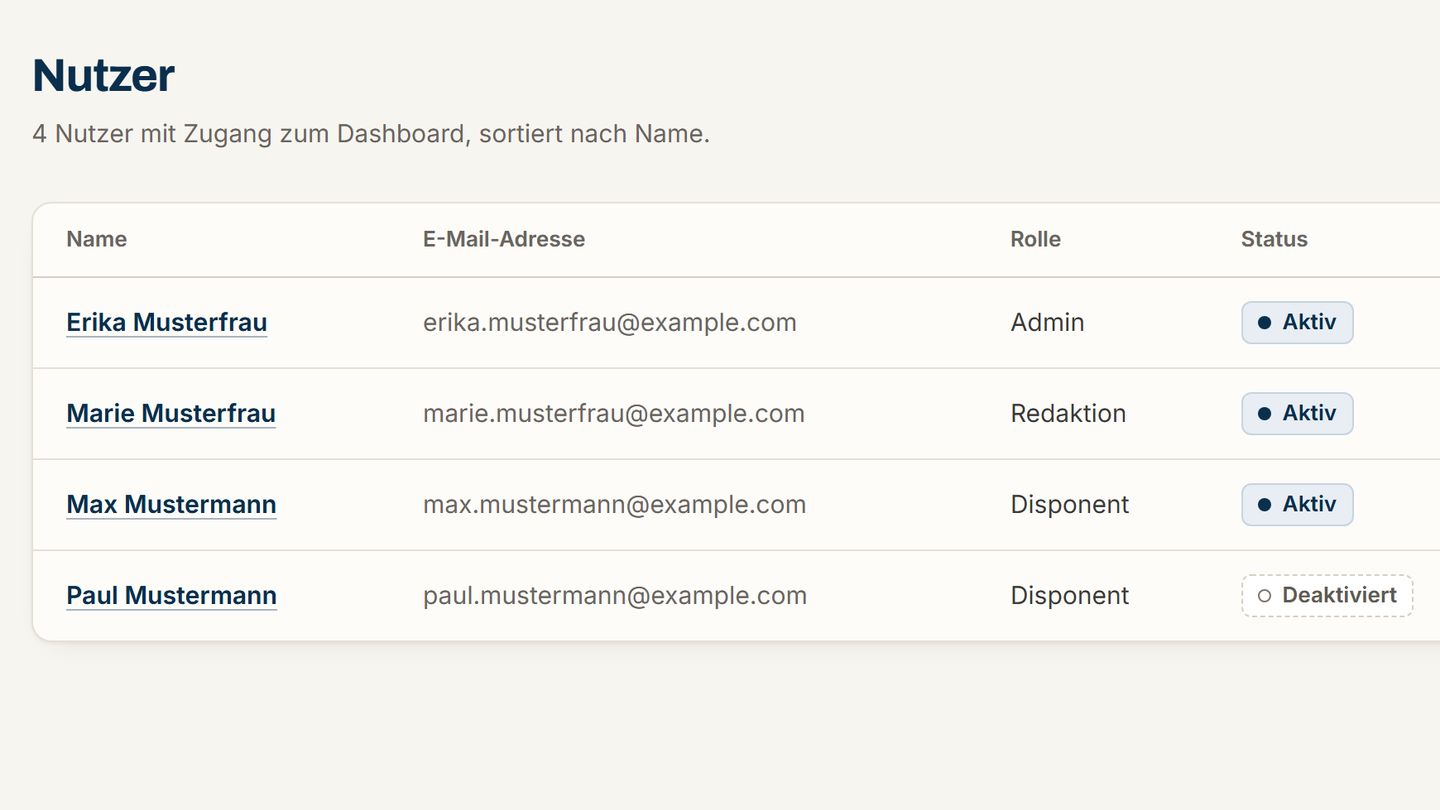
View with test data, captured on Nov 16, 2026 Service reports
Reports move from draft to approval to published; only administrators publish, and only with confirmed anonymization.
Filters by status; on a smartphone, each report is a card with town, service, vehicle and status
Dashboard · Service reports on a smartphone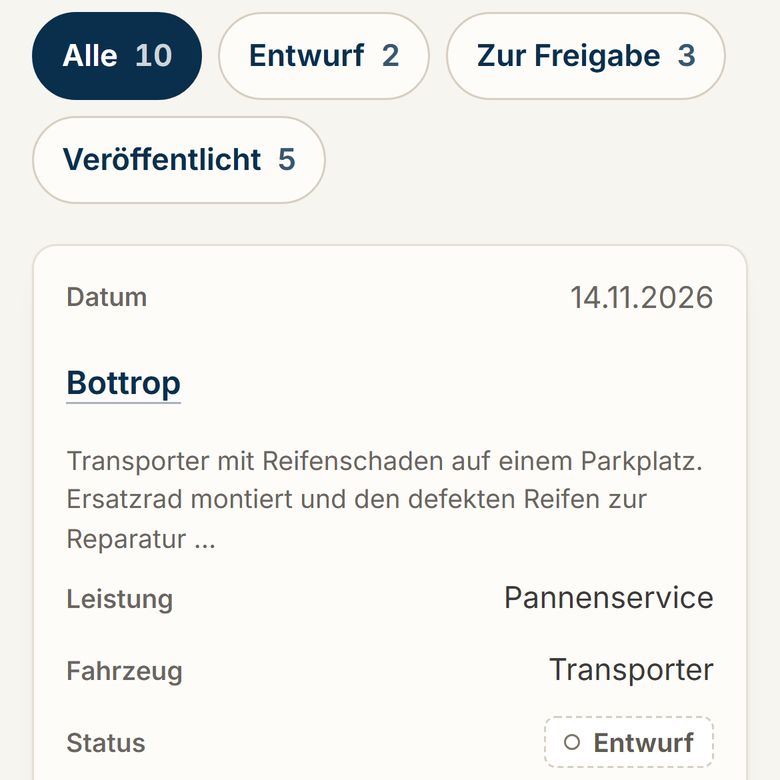
View with test data, captured on Nov 16, 2026 Anonymization before publishing
While you type, the form flags personal details; the “Anonymisiert” (anonymized) checkbox is required before publishing.
Required fields, a 40- to 1,500-character description, anonymization also enforced in the database
Dashboard · Editing a service report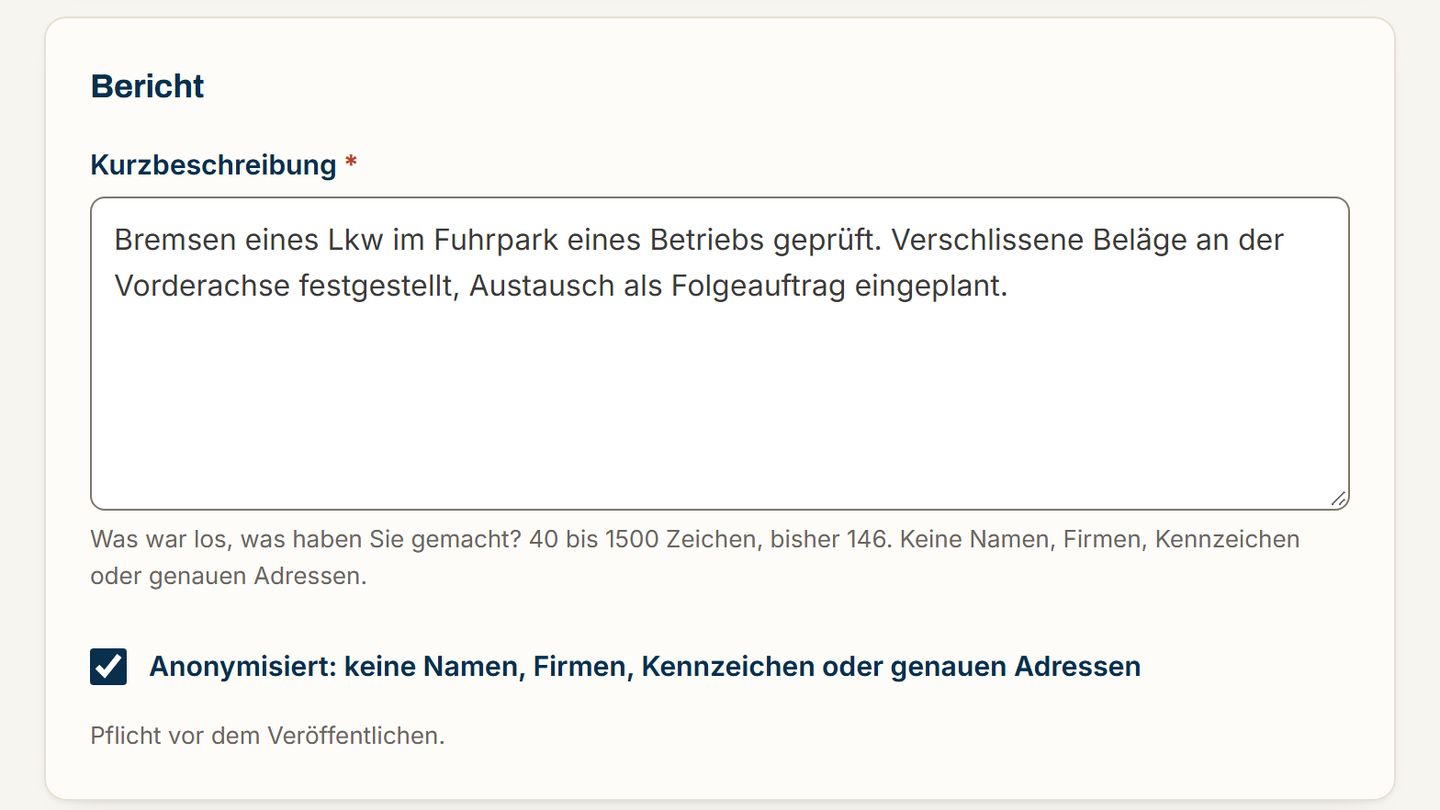
View with test data, captured on Nov 24, 2026
How do requests and content flow?
Two paths run through the system. Requests go from the contact form, signed, to the dashboard’s API and are stored encrypted in a PostgreSQL database; content goes from the same database through a checked build to the website as finished HTML.
- Contact form: Sends the request
- Form function: signs it (HMAC)
- API: 40 endpoints
- PostgreSQL: 24 tables
- Dashboard: three roles
- Build: snapshot on demand
- Website: finished HTML
Decisions
- Signatures and encryption The website passes a request on only with a signature, and the database holds name, contact and message only in encrypted form, each field with its own random value.
- One database for dashboard and website The dashboard and the website rest on the same PostgreSQL database; the content snapshot for the build comes from it and is byte-identical for the same data.
- Only confirmed facts go live Commitments the business has not confirmed, such as response times, never reach the HTML; if the build check finds one anyway, the build stops.
- Permissions on the server The server re-reads the role from the database on every call, and writes need a token tied to the signed-in account.
What was the starting point?
RuhrTruck combines a 24/7 emergency service with scheduled workshop work, and the website had to handle both. The company repairs truck, commercial vehicle and car tires on site and, by its own account, operates in 40 towns around Herten.
It also sells tires, repairs accident damage, provides expert reports and looks after fleets. A driver with a blown tire needs the emergency number right away; fleet managers want services and contacts. The old site was replaced by a new build on new hosting, including a domain transfer.
The brief was a new ruhrtruck.de, from planning to launch: search engine optimization with dedicated pages for the towns in the service area, preparing the site for AI assistants such as ChatGPT, Gemini and Perplexity, an editorial dashboard with three user roles, and the technical setup with hosting, the domain transfer and the contact form.
How is the system built and tested?
The website is built with Astro and serves finished HTML, and the dashboard with Astro and Svelte; the API runs as a Cloudflare Worker, and the data sits in PostgreSQL. Automated tests cover the path to the emergency number on five screen sizes and the dashboard’s workflows, among other things.
Layers
- User interfaces
- Website: Astro, finished HTML
- Dashboard: Astro with Svelte
- Contact form: website function
- Core
- API: Worker with signature check
- Sign-in with hashed passwords
- Role permissions on the server
- Data
- PostgreSQL with encrypted fields
- Content snapshot file for the build
- Operations
- Cloudflare Pages and Workers
- Deletion and daily EU backup, provided for in the system
Properties
- Handover
- signed (HMAC-SHA256), timestamped and valid only briefly
- Storage
- name, contact and message encrypted field by field (AES-256-GCM)
- Deletion
- right away on request; after twelve months, provided for in the system
- Backup
- daily, all tables to the EU; provided for in the system
- Roles
- dispatchers, editors, administrators; role re-read on every call
- Town pages
- own copy, distance from Herten, local FAQs, similarity check in the build
- Machine-readable
- one structured-data record per page, llms.txt, facts.json, Markdown
Quality
- Automated tests with Vitest and Playwright, including the path to the emergency number on five screen sizes and dashboard tests for sessions, security and requests.
- A town page is indexed only with its own minimum copy, a local reference and local FAQs; the build checks this.
What can be verified?
The site has been live since October 8, 2026, and the dashboard since October 15, 2026; from that day on, the pages for all 40 towns have also been open to Google Search.
After the first four weeks, we went through the search terms in Google Search Console. Since November 2026, terms that already earned impressions (appearances in search results) but had no matching page appear in titles, headings and copy. We will publish search and AI-answer figures only with a baseline, a period and a source.
How is ruhrtruck.de structured?
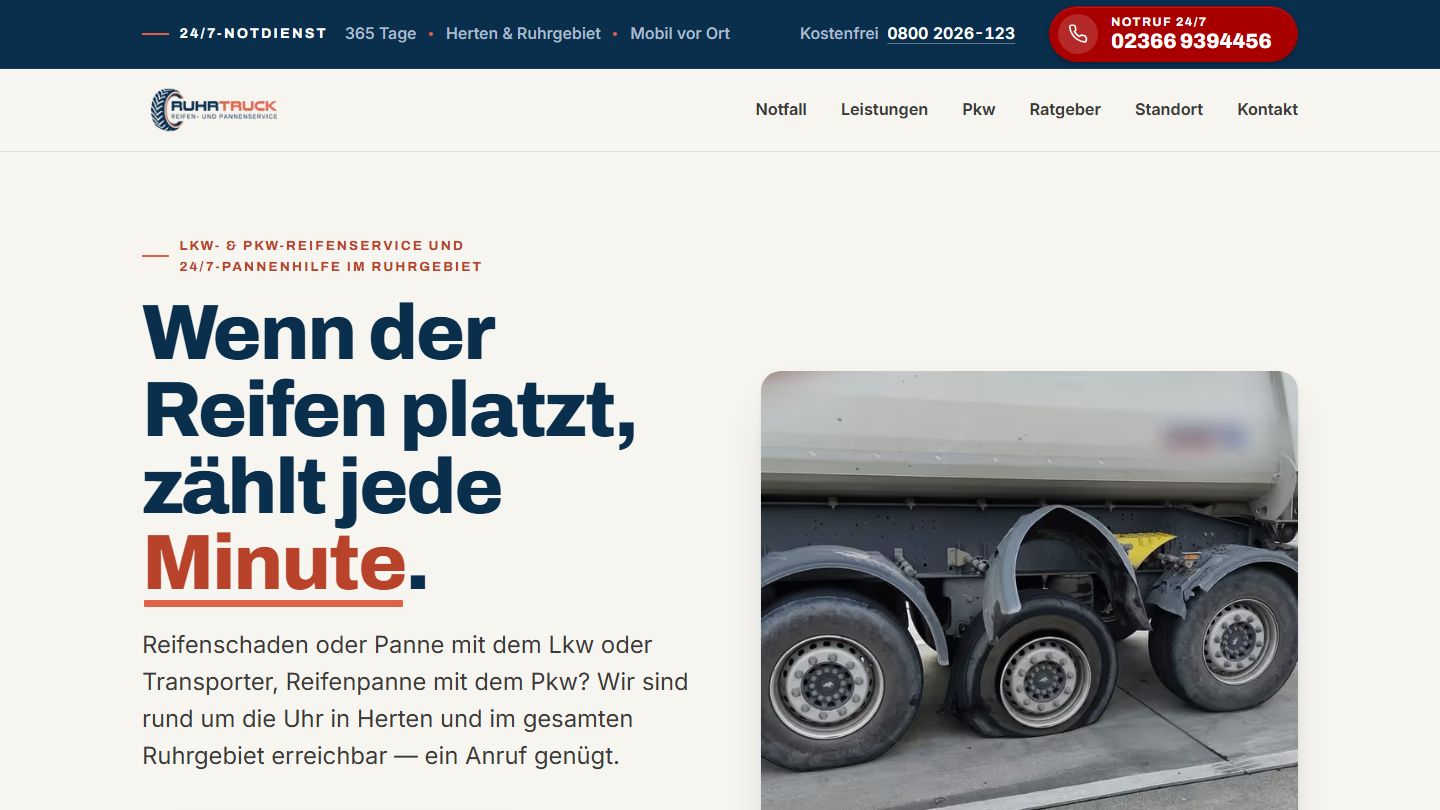
On November 22, 2026, the sitemap of ruhrtruck.de listed 203 pages. Each of the 40 towns served has an overview page and one page each for emergency tire service, breakdown service and tire service, with town-specific copy, the road distance from Herten and local FAQs.
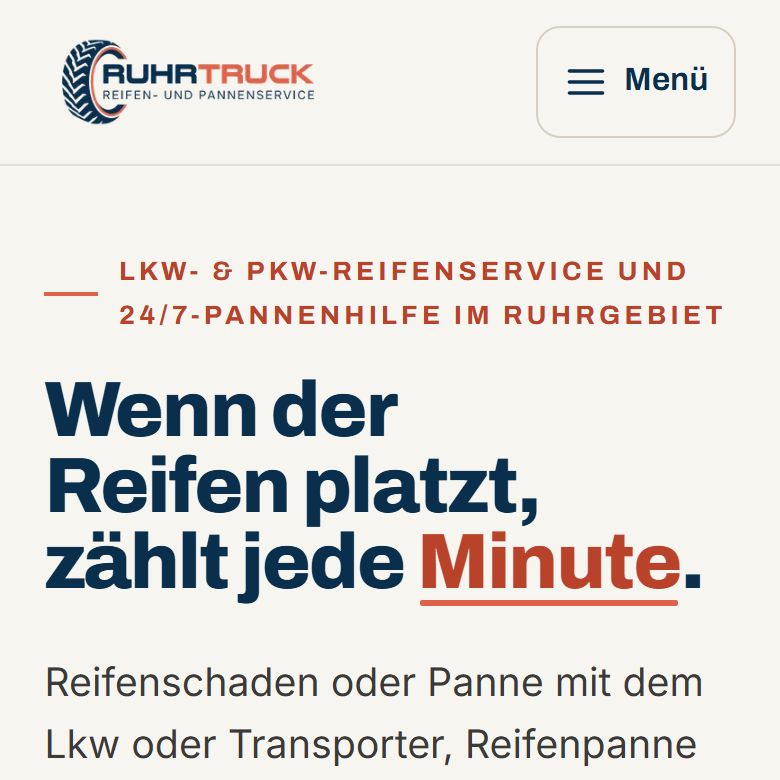
A check in the build flags pages whose copy is too similar. The emergency bar stays visible on every page, and every page loads as finished HTML without heavy JavaScript. That matters at the roadside, where the signal can be weak.
“Standort senden” (send location) shows the driver’s location at the tap of a button so it can be read out on the phone; the site neither sends nor stores it. Fonts, images and video come from the site’s own domain, there are no third-party scripts, and structured data describes the business on every page as one connected record.

For emergency services and large service areas, we work out in a call which town pages the area needs and whether a dashboard for requests and service reports fits the way you work.
A system like this for your business
30 minutes, free. Reply within one business day (Mon–Fri).
Project facts
- Project
- ruhrtruck.de with an editorial dashboard
- Client
- RuhrTruck (Ruhrtruck GmbH & Co. KG), Herten, Germany
- Timeframe
- Site live since Oct 8, 2026, dashboard since Oct 15, 2026; ongoing
- Role
- Planning, design, development, SEO and GEO, hosting and domain transfer
- Services
- Website, search engine optimization, generative engine optimization (GEO), editorial dashboard
- Technology
- Astro (finished HTML), Svelte, TypeScript, Cloudflare Pages and Workers; structured data, llms.txt, Markdown versions
- Status
- Live since Oct 8, 2026; search terms reviewed after four weeks, no published results yet
Results depend on the starting point and do not transfer to every project. Published with the consent of RuhrTruck.
More case studies
Editorial note
Researched and drafted with AI assistance. Mohammad Alboush has not yet checked the sources, figures and claims.
Content not yet reviewed
Changes to this report
Show all 7 changes
| Date | Type | Change |
|---|---|---|
| First publication | Version 1: starting point, brief, solution and what can be verified so far | |
| Correction | Removed the retention period for requests in the dashboard. The other statements remain the same. | |
| Update | Added test-data views of the dashboard, a section on its modules and details on the service reports. | |
| Update | Rebuilt as a system page: added the path of a request, the system architecture and a technology section, described deletion and backup as provided for in the system, and shortened the text. | |
| Update | Added figures from the source code: endpoints, tables and test cases, with the code version and the counting date. | |
| Correction | Cropped the screenshots for phones so their text is legible, and used a phone view of the dashboard for the requests. The statements remain the same. | |
| Correction | Captured a phone view of the form for the anonymization step so its text is legible. The statements remain the same. |
Spotted a mistake? Email us at kontakt@datafalke.de. We’ll fix it and log the change.