Client case study · Website and request management
VIA CERAMICA: website for a tile showroom
21 town pages cite local data from original sources; requests go to the site’s own protected request system.
What did Datafalke build?
Datafalke planned, designed and built viaceramica.de for VIA CERAMICA, an owner-run tile retailer with a showroom in Kamp-Lintfort, Germany. The site has been live since July 26, 2026, and replaces the previous WordPress site. The new site includes its own request management system, pages for 21 towns in its delivery area and 29 guides.
- Request management: Requests from the form go into the site’s own database and a protected list, and the system sends an email for each new one.
- Request form: Required fields, fixed option lists and spam protection without a CAPTCHA, with an optional photo or PDF.
- Town pages: Each of the 21 town pages lists the water hardness, a drop-off point for old tiles and the chamber of crafts, each with its source.
- For AI assistants: Structured data on all 84 pages, llms.txt, llms-full.txt and local data as CSV tables.
- No third-party servers: No page loads files from third-party servers, and the site sets no cookies.
- pages in the viaceramica.de sitemap
- 84
- page templates in the site’s code
- 22
- check scripts in the site’s code
- 14
- serverless functions for the form and the system
- 2
Counted in the source code on November 23, 2026, code as of September 17, 2026.
Later versions of the code were not reviewed here; the live site may differ.
VIA CERAMICA · counted live on November 16, 2026
What does the request system look like?
The request management system of viaceramica.de takes requests from the form, keeps spam out, sends an email for each new request and lists them all in a protected area. The system and form views show invented test data; for the screenshot, the system ran locally on its code as of September 17, 2026. The interface is in German.
Request list
The list shows the newest requests first and marks new ones; one click marks a request as read or unread again.
Counts for all and new requests, contact details link to email or phone
Request management · Appointment requests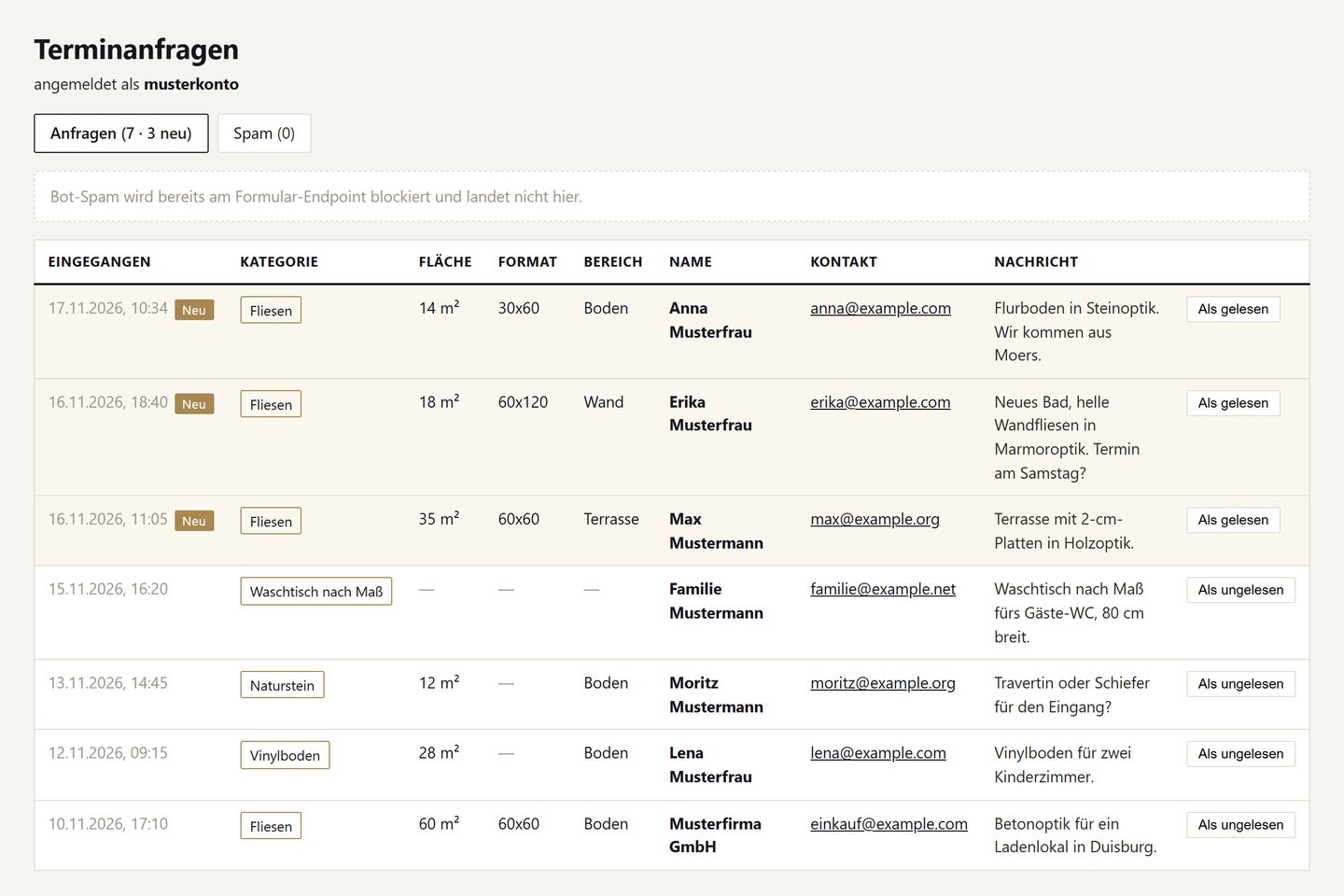
- The tabs count all requests and the new ones; the form rejects spam on submission.
- The newest request is at the top; unread requests are highlighted and marked “Neu” (new).
- The contact details are a link: one click opens an email to the sender.
- A button on each row marks a request as read or unread again, and the counts at the top update.
Request form
Category, name and phone or email are required; floor area, tile format, room, message and a file are optional. List values are checked server-side.
Four options each for category, format and surface; length limits for name, contact and message
Website · Request form on a smartphone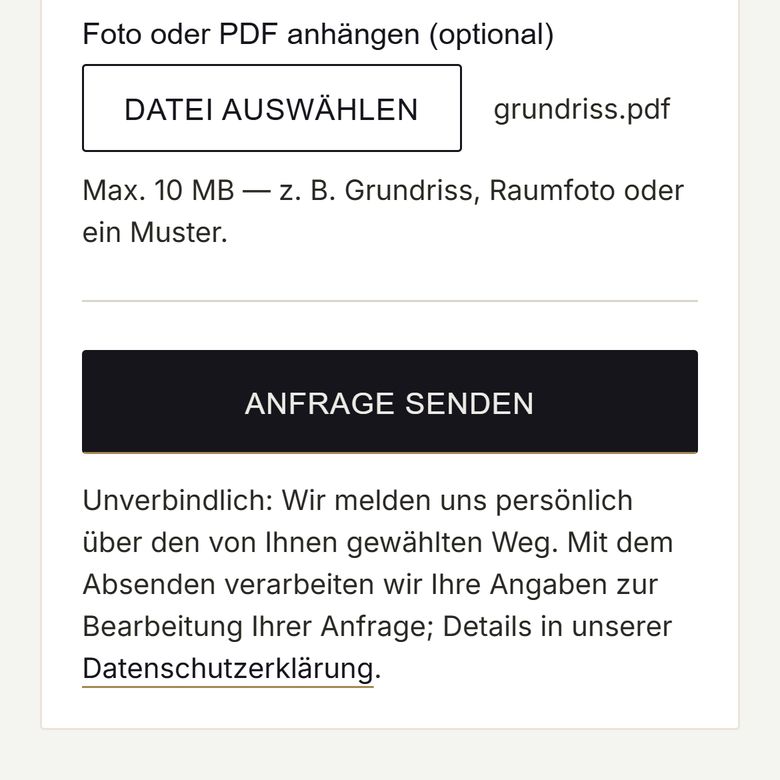
Page on viaceramica.de, captured on Nov 17, 2026 Spam protection without CAPTCHA
A hidden field, a time trap and checks on origin and content keep bots out; clear spam is rejected and never stored.
No third-party service and no cookie, plus a limit per sender
- Hidden field
- invisible to people, bots fill it in
- Time trap
- rejects a form sent too quickly
- Origin
- accepts requests only from the site itself
- Content
- checks name, contact and message for typical spam patterns
- Limit
- caps the number of requests per sender
- Result
- clear spam is rejected and not stored
Town pages with local data
Each town page gives the water hardness and a drop-off point for old tiles, each with its source, and links to the chamber’s business directory.
21 town pages with their own copy and questions; water hardness and drop-off points also as CSV
Website · Moers town page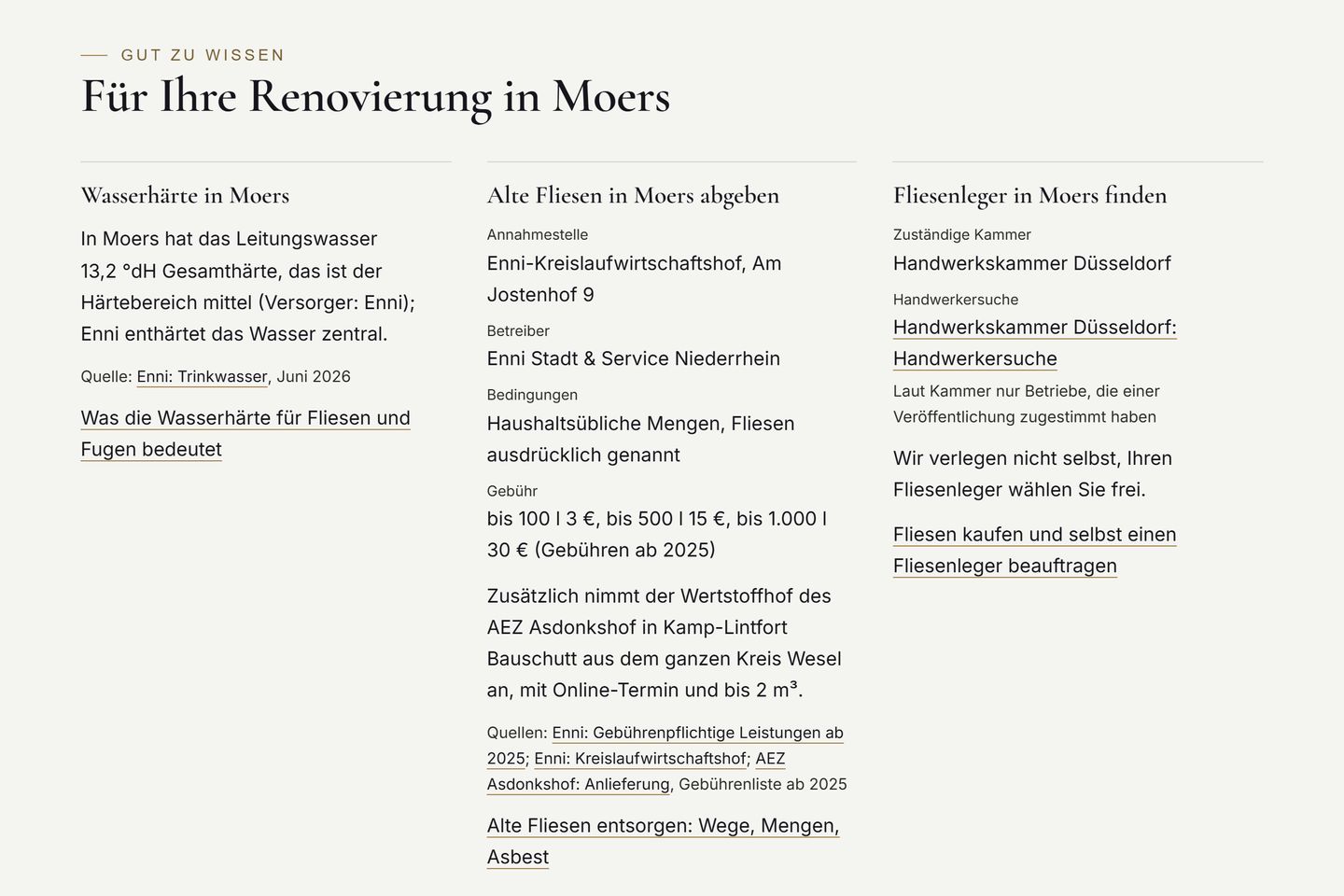
Page on viaceramica.de, captured on Nov 16, 2026 Guides
The 29 guides are grouped by topic, from bathrooms to buying advice, and each card shows its reading time and date.
Dated guides from how many tiles to order to slip resistance, plus a glossary of 20 terms
Website · Guides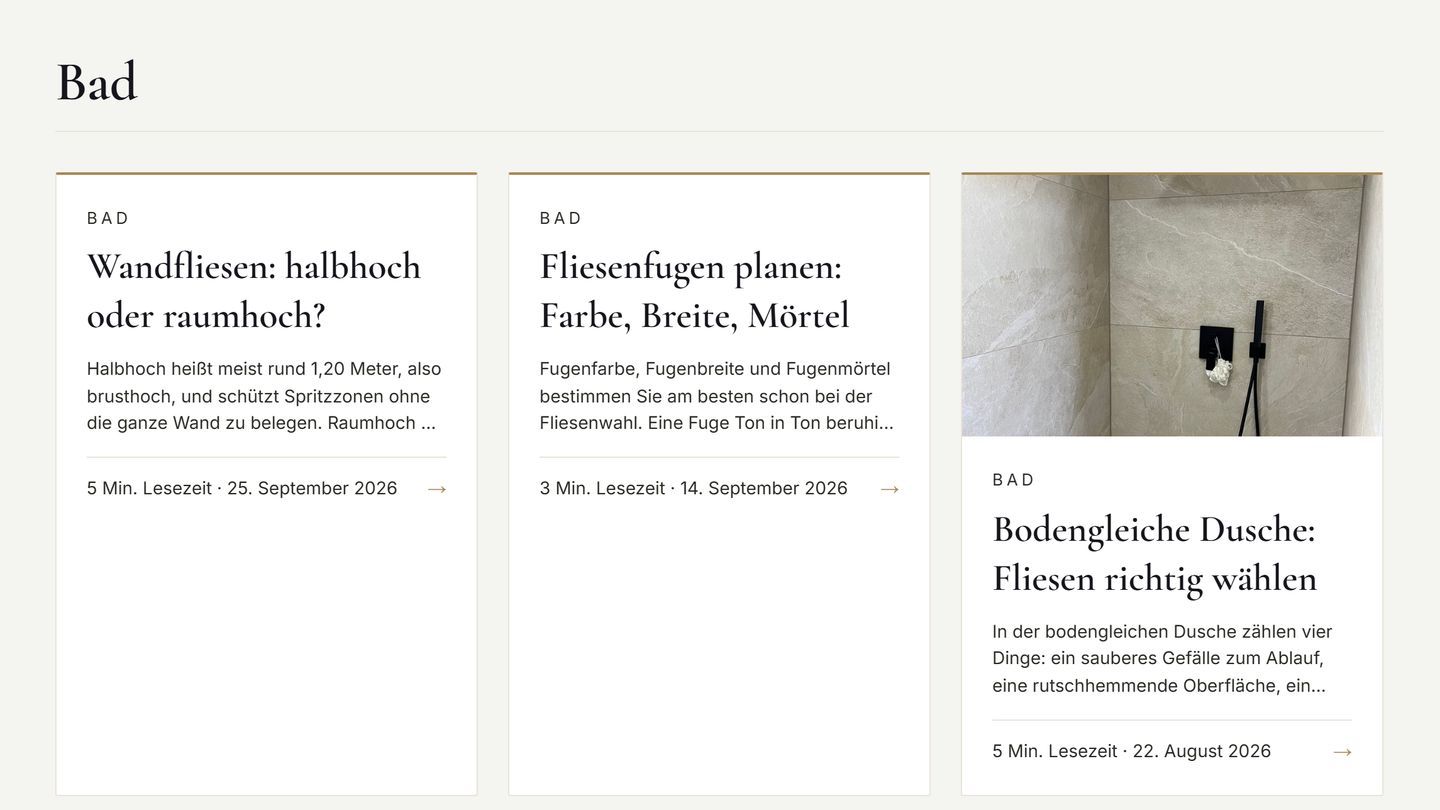
Page on viaceramica.de, captured on Nov 16, 2026 Data for search and AI
The “About this website” page lists the data the site provides for search engines and AI assistants, from structured data to local data as CSV tables.
Structured data on 84 pages, Wikidata links, llms.txt, llms-full.txt and an RSS feed
Website · About this website
Page on viaceramica.de, captured on Nov 24, 2026
How does a request reach the system?
The form sends to the site’s own serverless function, which checks the input and the spam rules, stores the request in the site’s database and emails VIA CERAMICA. The request management system reads from the same database, and the pages themselves are pre-rendered as static HTML.
- Website: static HTML
- Appointment form: no CAPTCHA
- Function: serverless, spam check
- Database: the site’s own
- Back office: sign-in required
- Email: to the store
Decisions
- Its own database for requests Every request is stored in the site’s own database and stays there even if the email fails to send.
- Spam protection in its own code A hidden field, a time trap and checks in the code keep bots out, so the form needs no CAPTCHA.
- Local data from original sources Each town page cites its sources for water hardness, drop-off points and the chamber of crafts, so it carries data about that specific town.
- Static HTML from its own domain Even AI crawlers that don’t run JavaScript read every page, and no page loads files from third-party servers.
What was the starting point?
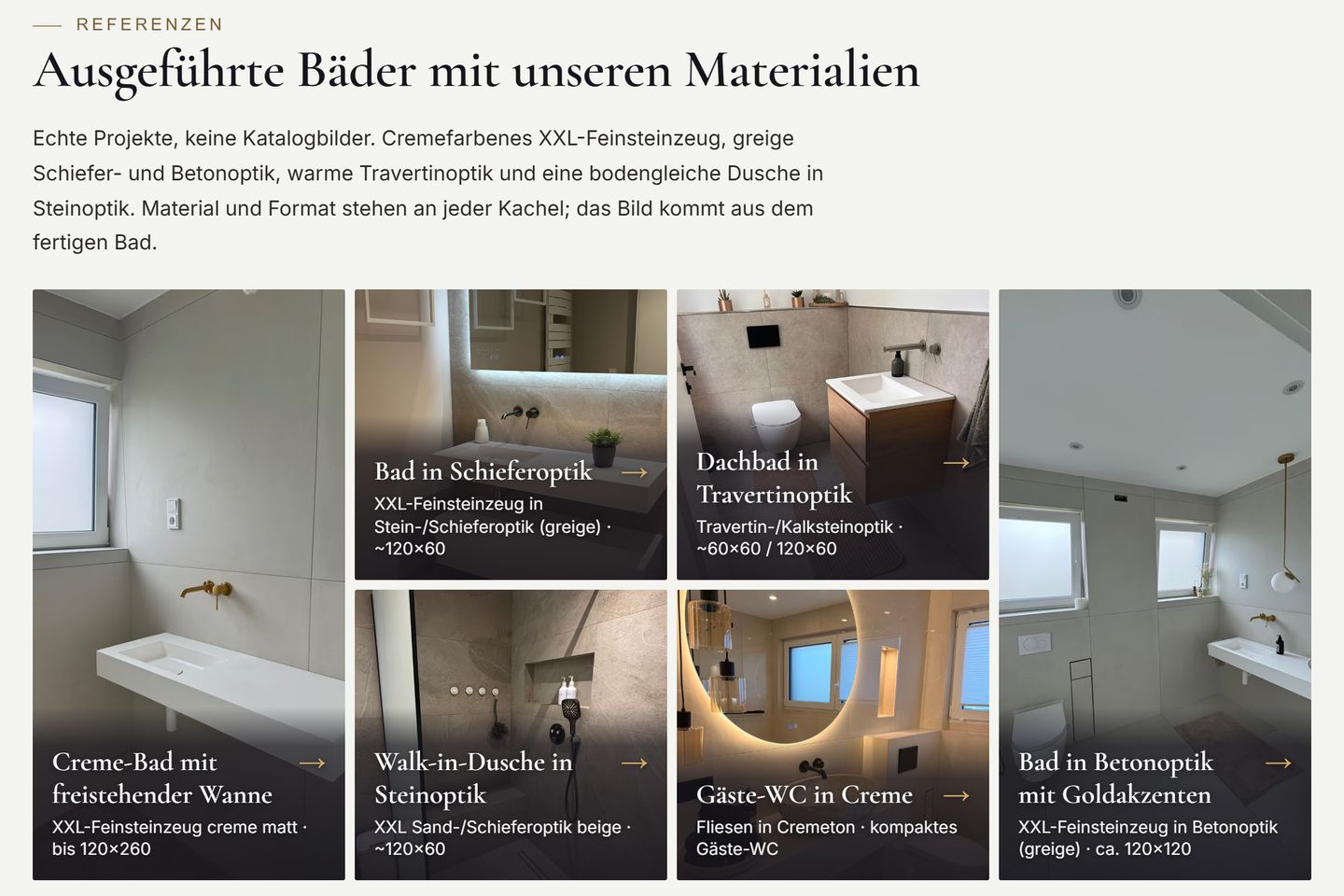
VIA CERAMICA advises customers in its showroom in Kamp-Lintfort and sells tiles there. Its delivery area covers 21 towns, including Moers, Duisburg, Rheinberg, Neukirchen-Vluyn and Wesel, and it also ships across Germany. The old site ran on WordPress.
VIA CERAMICA doesn’t lay tiles; customers hire a contractor of their choice. Datafalke was asked to take the site from planning to ongoing support. The brief covered dedicated pages for the towns in the delivery area and generative engine optimization (GEO), which prepares a site for AI assistants such as ChatGPT, Gemini and Perplexity. It also included a request form, the move from WordPress with redirects and a change of hosting.
How is the system built and tested?
The site is built with Astro and serves static HTML; in the code as of September 17, 2026, the form and the request management system are serverless functions with a dedicated database. Check scripts in the code test the structured data and the files for AI assistants, and the request management system opens only after sign-in.
Layers
- User interfaces
- Website: Astro, static HTML
- Request form with photo or PDF
- Request system after sign-in
- Core
- Serverless function for the form
- Serverless function for the request system
- Spam checks in its own code
- Data
- Dedicated database for requests
- Local data as CSV tables
- Operations
- Hosting migration on July 26, 2026
- Email for every new request
- Ongoing support
Properties
- Spam protection
- no CAPTCHA and no third-party service, with a limit per sender
- Access
- only after sign-in, locked until a password is set
- Cross-site forms
- changes only from the site’s own domain (CSRF protection)
- Storage
- dedicated database; if the email fails, the request is still stored
- Third parties
- no files from third-party servers on page load, photos also as AVIF and WebP
- Cookies
- none set by the site itself
- Redirects
- old WordPress URLs to matching new pages with a 301
Quality
- According to VIA CERAMICA’s “About this website” page, check scripts cover the structured data and the files for AI assistants.
- The code as of September 17, 2026, includes a browser test of the layout on different devices.
- Responses of the request management system stay out of caches and search indexes.
What can be verified?
As of November 16, 2026, the site is live, all 84 URLs in its XML sitemap return status 200, and every page carries structured data. All 21 town pages cite sources for water hardness, drop-off points and the chamber of crafts, and every page credits Datafalke as developer. We counted the site figures on viaceramica.de that day.
Measured · the site’s XML sitemap and structured data, URLs, pages, questions and terms counted
We’ll publish figures on rankings, clicks and requests once they cover a meaningful period.
How is viaceramica.de structured?
On November 16, 2026, the sitemap listed 84 pages: 21 town pages, 29 guides, 11 project pages, a glossary of 20 technical terms and other pages such as the home page and contact page. FAQ sections on 62 pages hold 302 questions in total, and no question appears twice word for word.
Technical terms and places such as porcelain stoneware (Feinsteinzeug), travertine and Kamp-Lintfort are linked to their entries in Wikidata, the free knowledge base, and every page carries structured data that points to the business through one shared identifier. Permanent redirects (301) send the old WordPress URLs to matching new pages, and the llms.txt file offers AI assistants an overview.
AI crawlers that don’t run JavaScript can read every page in full; our article on JavaScript and AI crawlers explains why that matters. Our article on a contact form without tracking shows how a form keeps spam out without a CAPTCHA.

In development: commerce system
What online store is being built?
Since September 2026, Datafalke has been building an online tile store for VIA CERAMICA on Medusa and Astro: catalog, carton calculator, cart, checkout, invoices, legal texts and withdrawal. The store is in development and not live; payments run in test mode only. The views show a local installation with invented test data; the interface is in German.
- Tile logic: The calculator turns square meters into whole cartons with waste per laying pattern, and every tile shows its unit price per m².
- Purchase flow: Cart in cartons, checkout with an order button, payment on an external payment service’s page and an invoice as a PDF.
- Legal rules in code: Versioned legal texts, withdrawal in the customer account, invoice numbers from a counter and dedicated checks for unit price and order button.
- Check chain: Post-build checks stop any build that still contains test prices or a test version of the legal texts.
- custom modules
- 20
- custom tables
- 21
- post-build checks
- 31
- test types in the code
- 6
Counted in the source code on November 23, 2026, code as of November 21, 2026.
The store is in development and not live.
Carton calculator
The calculator turns a floor area into whole cartons, including waste. It suggests a waste rate per laying pattern, which customers can change.
Waste from 5 to 15%, always rounded up, spare carton only on request; the calculation core needs 100% test coverage
Store · Product page with calculator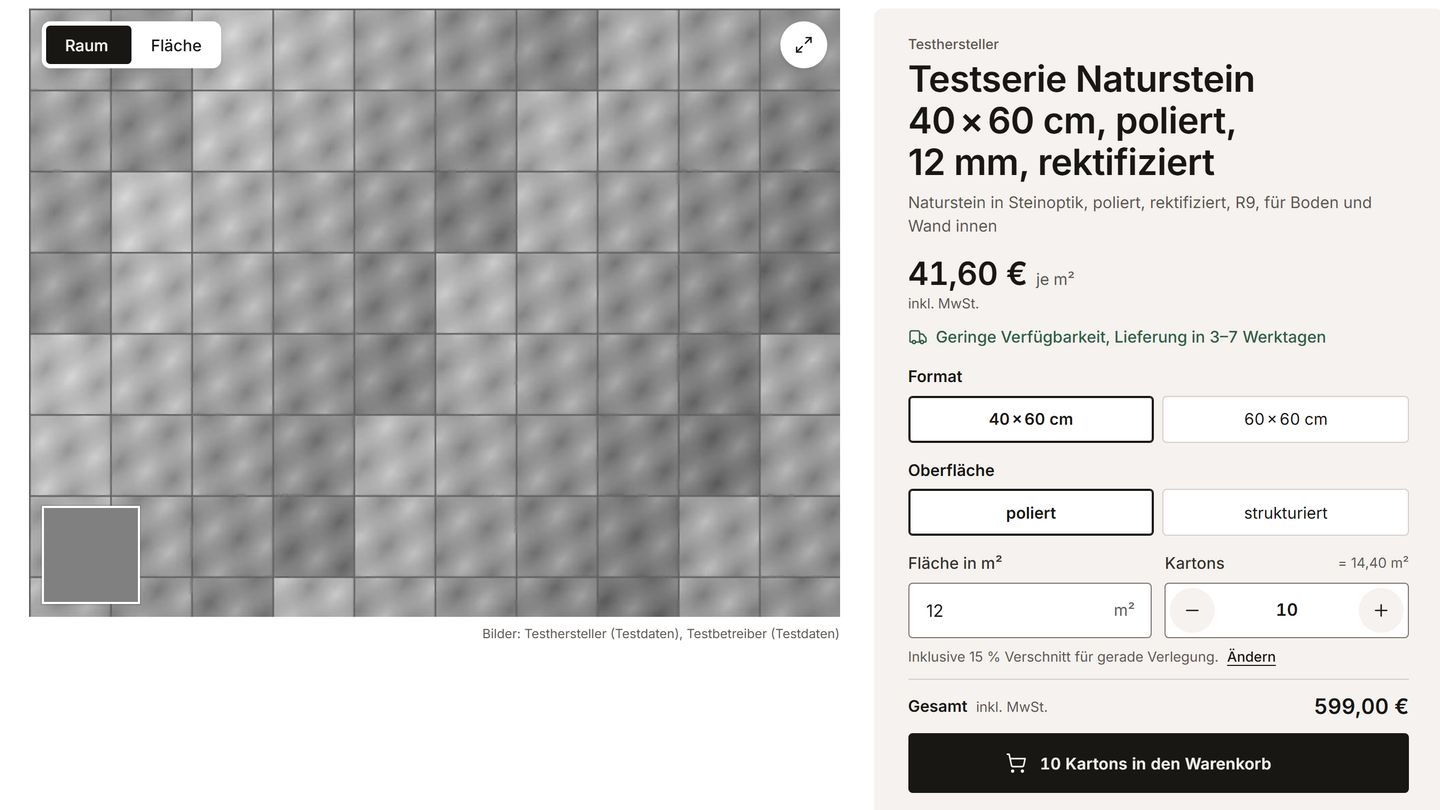
- The price is shown per m² as the unit price; the same figure appears in the page’s structured data.
- The calculator rounds up to whole cartons and shows the area they actually cover.
- The system suggests the waste rate per laying pattern; customers adjust it with “Ändern” (change).
Technical data
Each tile has its own data, from thickness and carton contents to slip and frost resistance; the page explains those two with the relevant standards.
Barefoot slip class, PEI class, areas of use and cartons per pallet; the database enforces the rules as well
Store · Technical data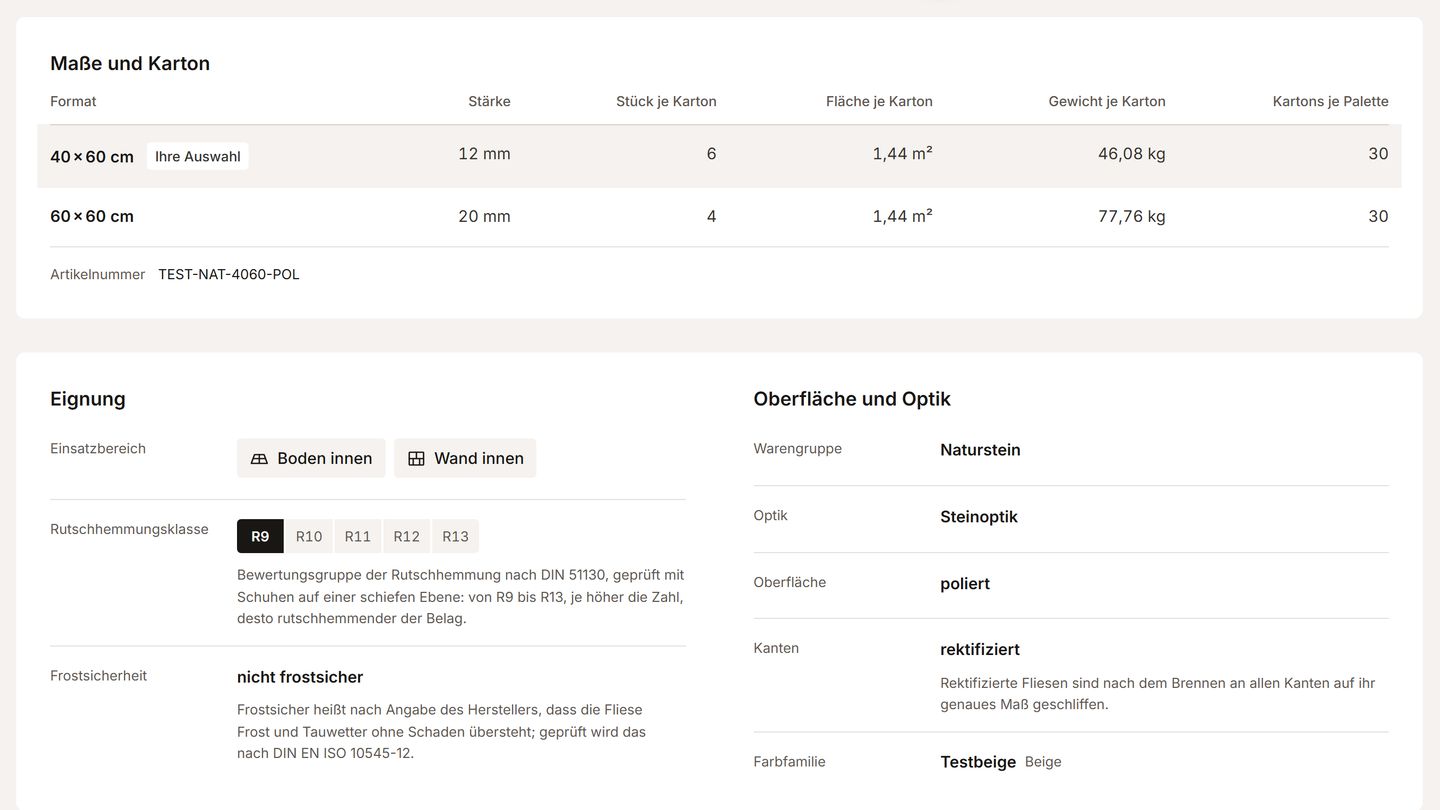
View with test data, captured on Nov 21, 2026 Formats to scale
A floor plan lays each format on a 3.60 × 3.60 m floor and gives the number of tiles, the joint length and the area per tile, without any JavaScript.
Figures computed from the catalog at build time; CSS handles switching between formats
Store · Formats to scale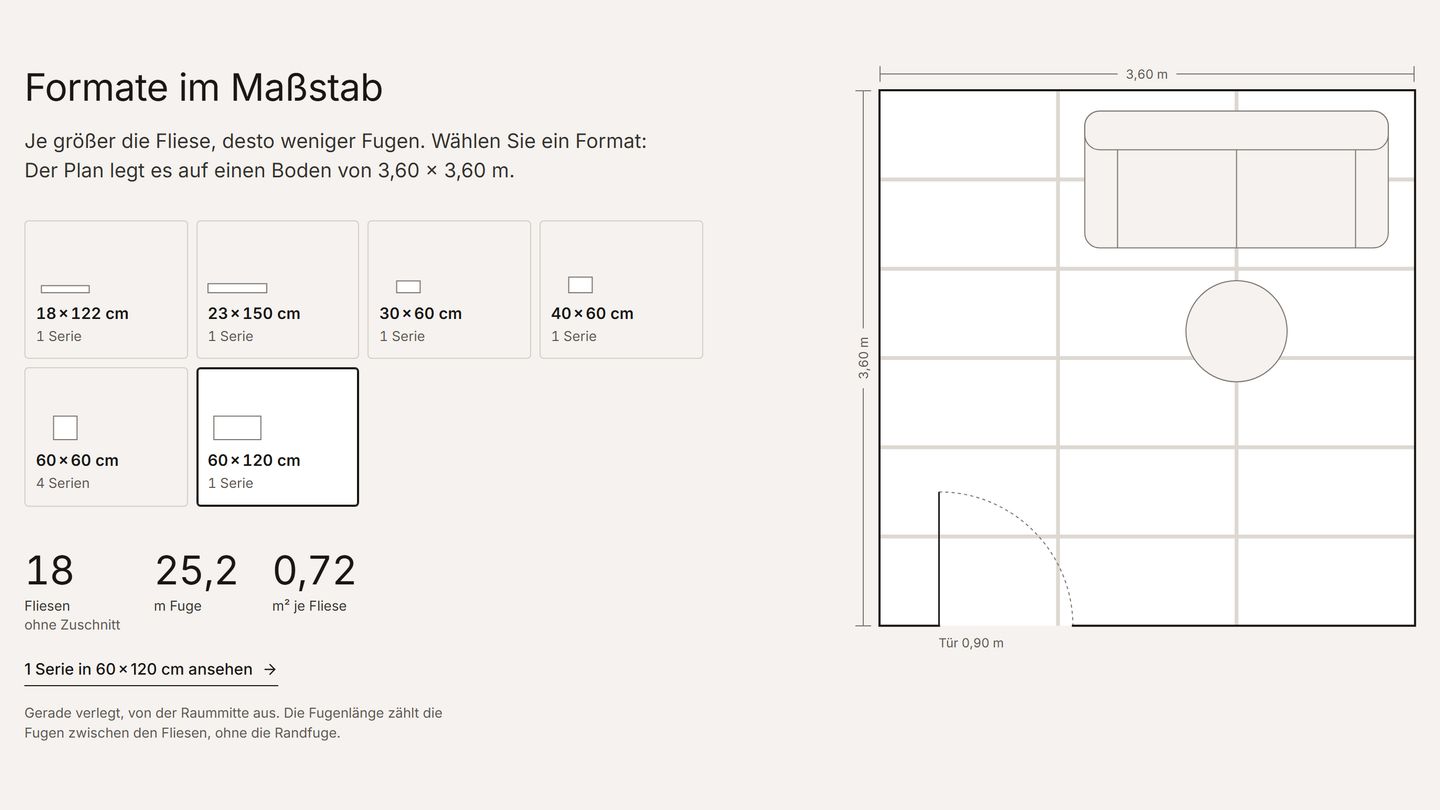
View with test data, captured on Nov 21, 2026 Cart and checkout
The cart lists each item in cartons with the area it covers; checkout ends with one “zahlungspflichtig bestellen” (order and pay) button.
Unit price per m², delivery time per item, freight by weight and zone, payment on the payment service’s page
Store · Cart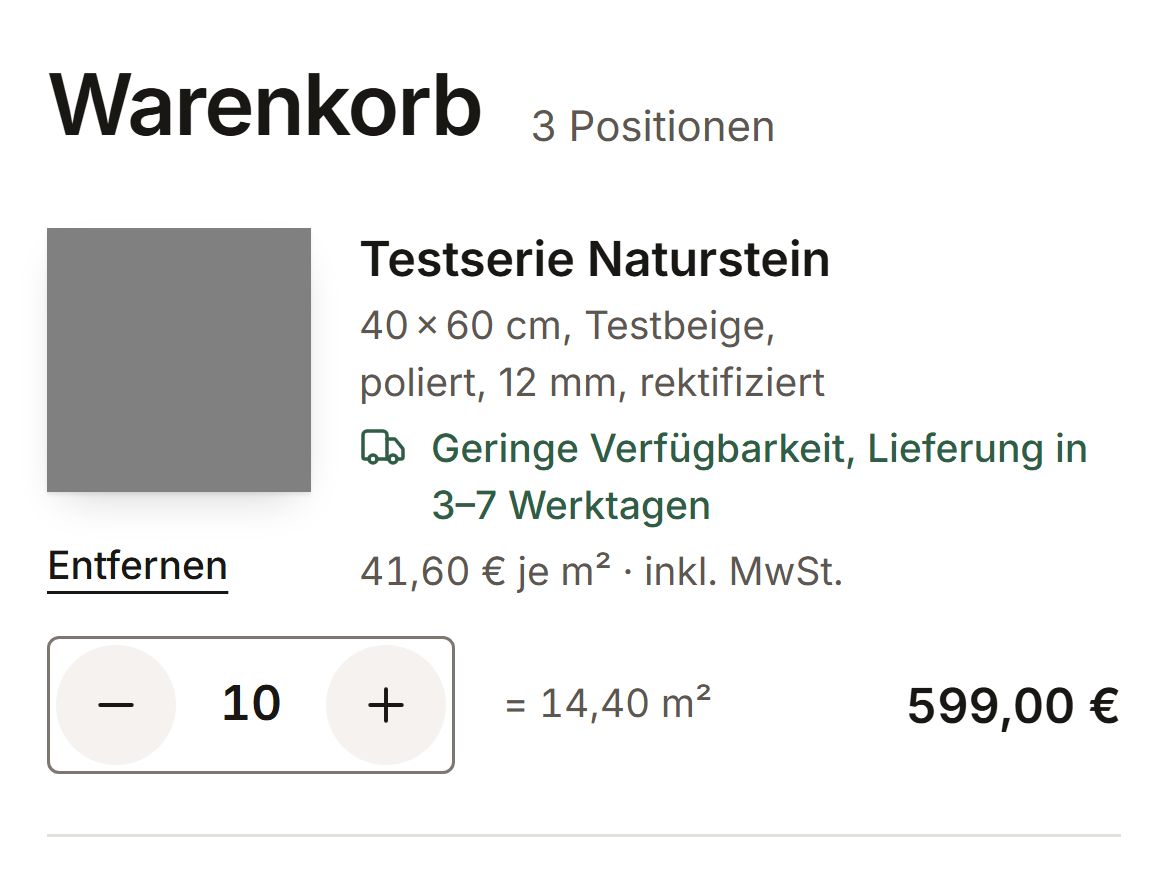
View with test data, captured on Nov 21, 2026 Store · Checkout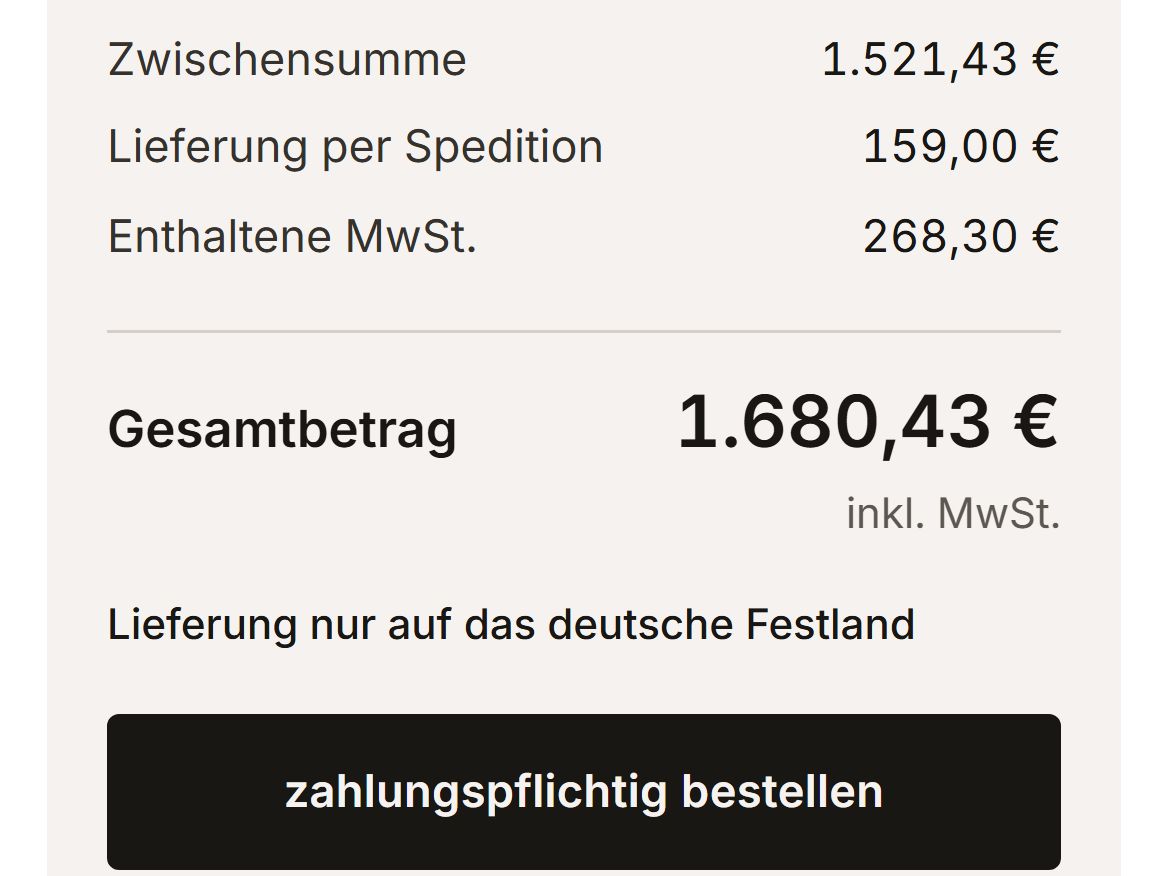
View with test data, captured on Nov 21, 2026 Versioned legal texts
The admin keeps legal texts in versions with a checksum; a released version never changes, and each order records which versions applied.
Custom page in the Medusa admin; draft, released and archived states, valid from a set date
Admin · Legal texts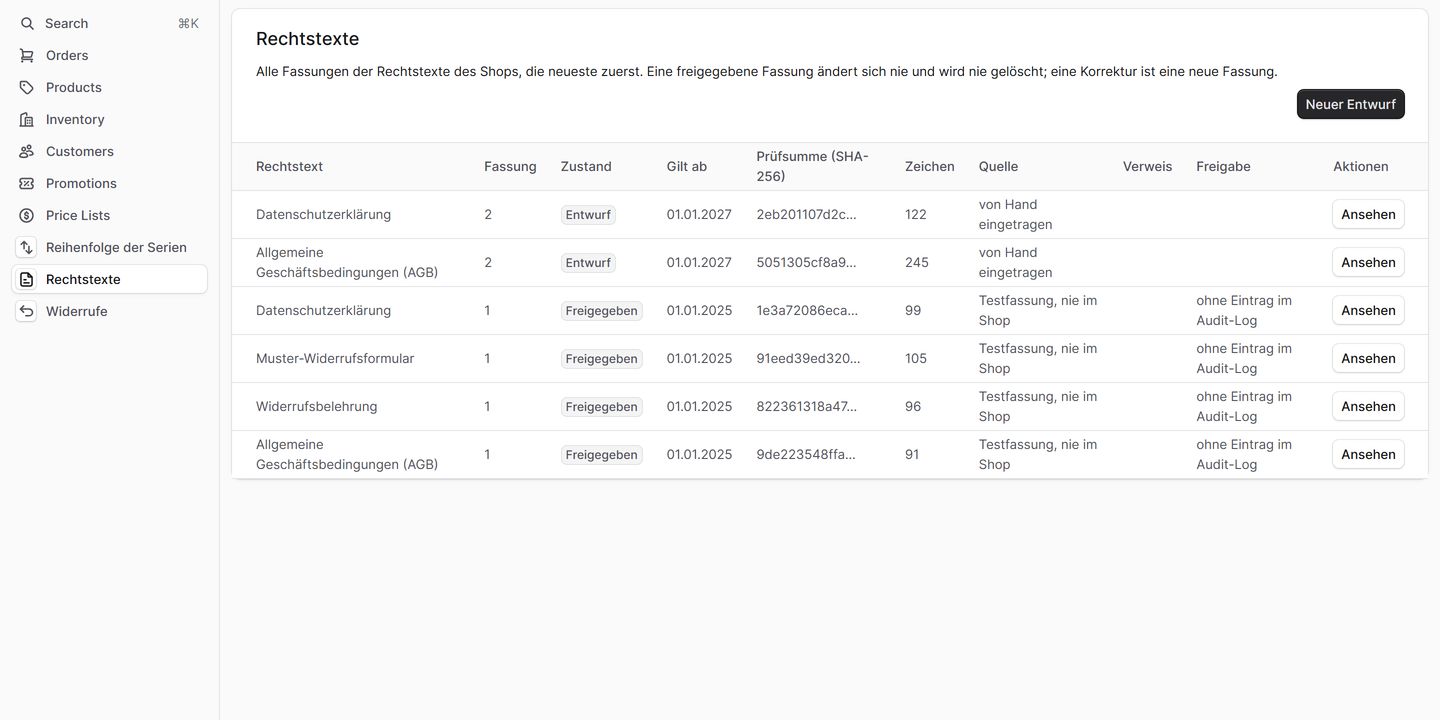
View with test data, captured on Nov 21, 2026
How do the store’s parts fit together?
The store’s pages are built as static HTML from the catalog. Cart, checkout and account run through serverless functions on the same domain, the backend for frontend (BFF); only behind it sits the commerce backend with its database. Images live in object storage, and payment happens at the payment service.
- Storefront: HTML from the catalog
- BFF: serverless, own domain
- Commerce backend: 20 custom modules
- Media: images in object storage
- Payment service: hosted payment page
- Database: 21 custom tables
Decisions
- Catalog as static HTML Pages are built from a snapshot of the catalog and do not need the backend; the browser checks price and stock through the store’s own domain.
- Payment at the payment service Customers enter payment details only on the payment service’s hosted page; the order relies on the status the backend fetches from it.
Which legal duties are in the code?
German online retail rules are built into the code, several with their own check: order button, unit price under the Price Indication Ordinance (PAngV), versioned legal texts, withdrawal and invoice numbers. The list describes these mechanisms; the business is responsible for the wording of its legal texts.
- Order button (§ 312j BGB)
- a check requires exactly one “zahlungspflichtig bestellen” button, right after the order summary
- Unit price (PAngV)
- per m², computed in whole numbers; a check matches the visible prices against the structured data
- Legal texts
- versions with a checksum; a released version never changes, and each order records its versions
- Withdrawal
- declared in the customer account, stored once and never changed; the system confirms receipt by email
- Invoices
- PDF from the order; numbered per series and year, and an aborted run uses no number
- Product safety, packaging
- manufacturer details under the EU General Product Safety Regulation (GPSR); German Packaging Act master data
Retailers who want to sell online alongside a showroom settle two questions first: what logic does the product range need, and which legal duties must the store cover?
A system like this for your business
30 minutes, free. Reply within one business day (Mon–Fri).
Project facts
- Project
- viaceramica.de with request management; replaces a WordPress site
- Client
- VIA CERAMICA, Viaceramica UG (haftungsbeschränkt), Kamp-Lintfort, Germany
- Timeframe
- Site live since Jul 26, 2026; ongoing support
- Role
- Planning, design, development, SEO and GEO, hosting migration and ongoing support; VIA CERAMICA is responsible for the content
- Services
- Website, search engine optimization, generative engine optimization (GEO), request management
- Technology
- Astro (static HTML), serverless functions with a dedicated database for the form and requests; structured data, llms.txt, llms-full.txt, CSV and RSS
- Status
- Live since Jul 26, 2026; no published results yet for search or requests
- Verifiable
- VIA CERAMICA credits Datafalke as developer in the footer of every page, in its legal notice (Impressum) and on its “About this website (external site)” page.
Results depend on the starting point and do not transfer to every project. Published with the consent of VIA CERAMICA.
More case studies
Editorial note
Researched and drafted with AI assistance. Mohammad Alboush has not yet checked the sources, figures and claims.
Content not yet reviewed
Changes to this report
Show all 7 changes
| Date | Type | Change |
|---|---|---|
| First publication | Version 1: starting point, brief, solution and what can be verified so far | |
| Update | Added a test-data view of the request system, the request form on a smartphone and a section on its modules; the glossary and smartphone town page views were removed. | |
| Update | Rebuilt as a system page: added the path of a request as a flow, the architecture of the request system and a technology section, and shortened the text. | |
| Update | Added figures from the site’s code: page templates, check scripts and the functions for the form and the request system, with the code version and the counting date. | |
| Correction | Cropped the screenshots for phones so their text is legible, and adjusted the markers and image descriptions. The statements remain the same. | |
| Update | Added part 2, “In development: commerce system”: the business’s online store in development, with views from a local test installation, its architecture and legal duties in code. | |
| Correction | Added a phone capture of the “About this website” page so its text is legible. The statements remain the same. |
Spotted a mistake? Email us at kontakt@datafalke.de. We’ll fix it and log the change.