Client case study · Website and request management
Asbesta Schadstoffsanierung: website across NRW
428 pages for 13 services and 37 towns; each request reaches a protected request system with its source and status.
What did Datafalke build for Asbesta?
Datafalke planned, designed and built the 428-page website of Asbesta Schadstoffsanierung, an owner-run specialist firm in Marl, Germany: pages for 13 services and 37 towns in North Rhine-Westphalia, 28 guides, a knowledge base and a protected area where every request arrives with its source. The site loads no files from third-party servers and credits Datafalke as its developer.
- Service and town pages: A page for each of 13 services and 37 towns, plus 338 pages that combine a service with a town.
- Request management: Requests reach a protected area with their landing page and source, a status and fixed retention periods.
- No CAPTCHA: A hidden field, a timestamp, content checks and a per-sender limit, with suspicious requests held in quarantine.
- Sourced knowledge: The 28 guides state their date and sources; the knowledge base explains 32 terms and eight regulations.
- No third-party servers: Fonts, images and videos are hosted on the site’s own domain, and the security policy (CSP) allows only that source.
- pages in the asbesta-schadstoffsanierung.de sitemap
- 428
Asbesta Schadstoffsanierung · counted live on November 21, 2026
How does a search become a request?
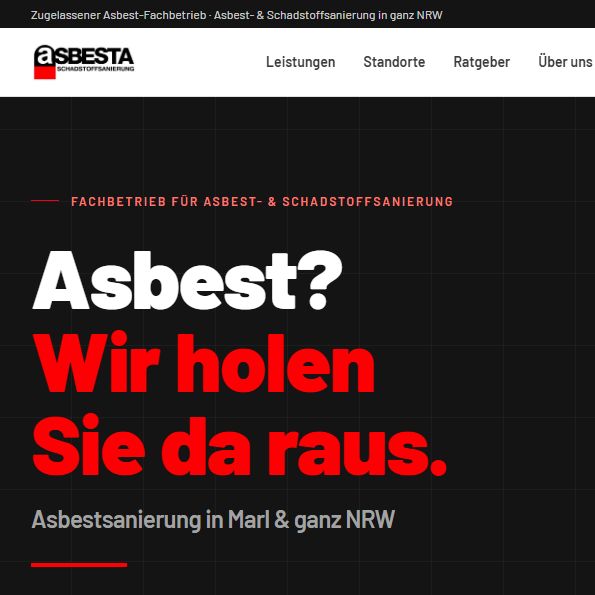
Service and town pages lead to a form without a CAPTCHA, and every request reaches a protected area along with its source. Guides and a knowledge base explain the technical terms with sources. The images show public pages of the site, captured on November 16, 2026.
Locations
The locations page groups the 37 towns by region, and each town page names a district government (Bezirksregierung) as the responsible authority.
13 service pages, 338 service-and-town pages, reviews with sources on 12 town pages
Website · Locations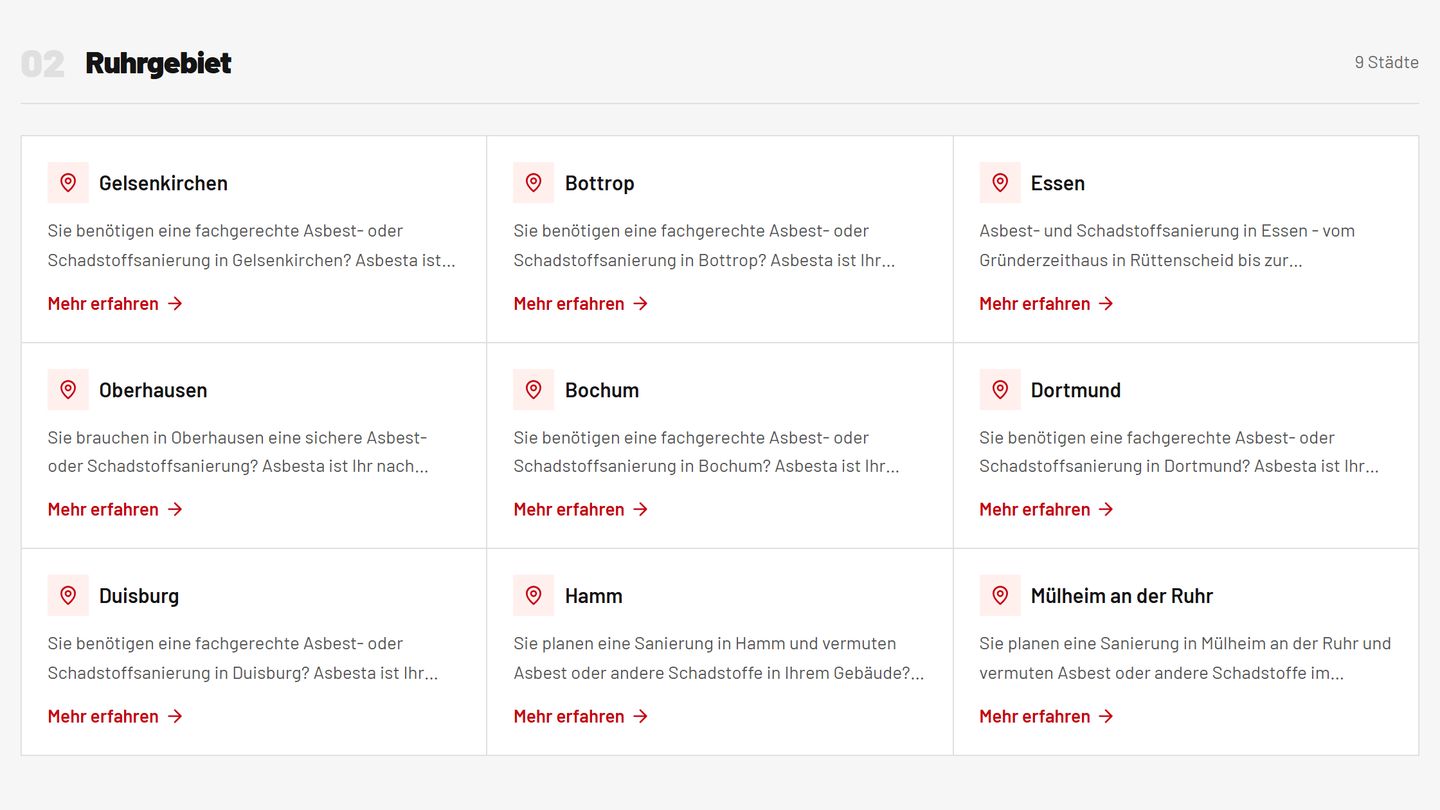
- The page groups the 37 towns by region and gives the number of towns in each.
- Each town has a page of its own, and its tile links there with “Mehr erfahren” (learn more).
Knowledge base
The knowledge base explains 32 terms and eight regulations and links 16 entries to Wikidata, so search engines and AI assistants can identify them.
A schema.org Dataset with license and date, licensed under CC BY 4.0 according to the site
Website · Knowledge base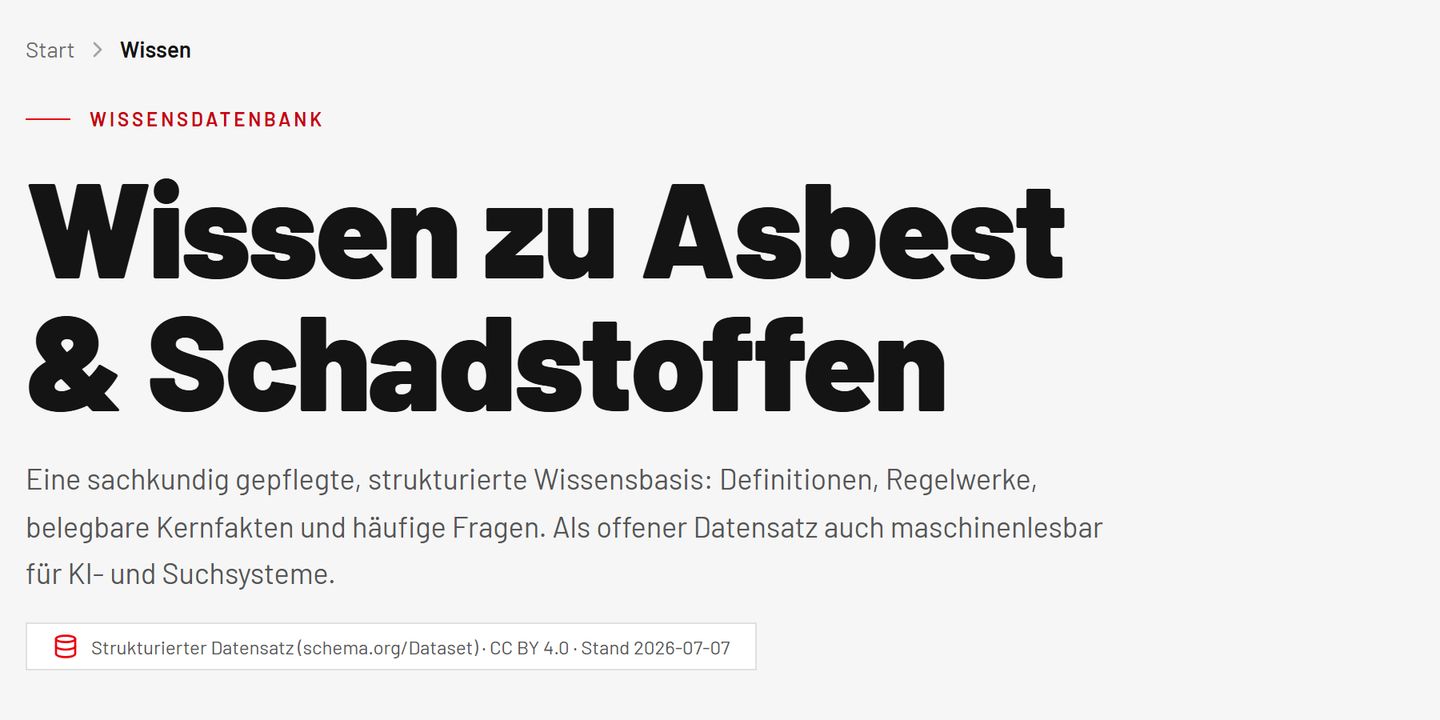
Page on asbesta-schadstoffsanierung.de, captured on Nov 24, 2026 Requests
The form asks for six details without a CAPTCHA, and every request carries its landing page and its source.
Hidden field, timestamp, content checks, per-sender limit; quarantine, status, retention periods
Website · Request form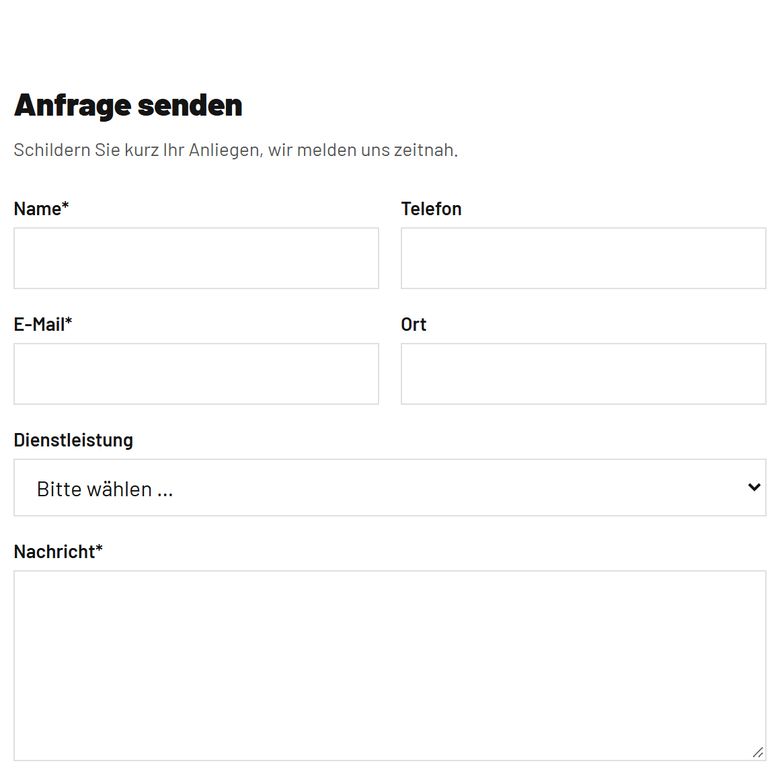
Page on asbesta-schadstoffsanierung.de, captured on Nov 24, 2026 For search and AI
Schema.org structured data describes the business, services, questions and guides, and four files summarize the content for AI assistants.
robots.txt allowing 26 search and AI user agents by name
- Structured data
- business, owner with proof of expertise, services, questions and answers, guides
- Check script
- validates the structured data and checks that every reference has a target
- llms.txt, llms-full.txt
- summarize the content, with the core facts and sources at the top
- facts.json, entities.json
- facts and entries in machine-readable form
- robots.txt
- allows user agents of OpenAI, Perplexity, Anthropic, Google and Apple
How is the Asbesta website structured?
The site has 428 pages: 13 service pages, 37 town pages, 338 service-and-town pages, 28 guides, a knowledge base and other pages such as the home, contact and reviews pages. According to the build documentation of November 15, 2026, 374 redirect rules (301) send the URLs of the old WordPress site to matching new pages.
The redirects are based on the old URLs from Google Search Console and an analysis of their pattern; our website migration checklist covers the steps of such a move. The pages carry structured data based on schema.org. The landing page sent with every request shows which pages bring in requests, and our article on a contact form without tracking explains how a form keeps spam out without a CAPTCHA.
The 28 guides state their date and their sources, such as Germany’s Ordinance on Hazardous Substances, the Technical Rule for Hazardous Substances TRGS 519, the German Environment Agency and the German Cancer Research Center’s Cancer Information Service. According to the website, the owner of Asbesta Schadstoffsanierung is responsible for the subject-matter content. A dedicated page shows reviews from four platforms (Google, MyHammer, golocal and 11880), links each review to the company’s listing on that platform and includes a note on authenticity.

How do the parts fit together?
The form sends to the site’s server, which checks the request, stores it in a PostgreSQL database and holds anything suspicious in quarantine. In the request system, every request has a status and its source. The pages themselves are generated ahead of time as finished HTML and load files only from the site’s own domain.
- Website: prebuilt HTML
- Request form: no CAPTCHA
- Server: spam quarantine
- PostgreSQL: requests with status
- Request system: retention periods
Decisions
- Finished HTML from its own domain Every page exists ahead of time as HTML, and the server’s security policy (CSP) allows only the site’s own domain as a source, plus exactly one approved inline script.
- Spam checks without a CAPTCHA service A hidden field, a timestamp, content checks and a per-sender limit replace a third-party service.
- Quarantine for suspicious requests Suspicious requests go into quarantine and are kept there.
- A source on every request Each request carries its landing page and source, so the business can see which pages bring in requests.
What was the starting point?
By its own account, Asbesta Schadstoffsanierung serves all of North Rhine-Westphalia (NRW) from its base in Marl. Its old website ran on WordPress, and its URLs followed a different pattern from the new site’s: service and town were combined in a single URL directly under the domain.
Asbestos is a health issue, and search engines apply especially strict standards to pages on such topics. The new site therefore had to show who stands behind its statements as a subject-matter expert and make every service findable in every town for search engines and AI assistants alike.
Datafalke was asked to deliver the website from planning through request management, with service and location pages across North Rhine-Westphalia and generative engine optimization (GEO), which prepares the site for AI assistants. The brief also called for a protected request system that sends an email alert for every new request and catches form spam, and the old URLs had to redirect without loss.
From the reference approval by Asbesta Schadstoffsanierung
“Datafalke hat für uns die Website asbesta-schadstoffsanierung.de konzipiert, gestaltet und entwickelt – mit SEO, Optimierung für KI-Assistenten und einer Verwaltung für unsere Kundenanfragen. Wir haben alles aus einer Hand bekommen und einen festen Ansprechpartner.”
Translated from German by Datafalke
Datafalke planned, designed and developed the website asbesta-schadstoffsanierung.de for us, with SEO, optimization for AI assistants and a system for managing our customer inquiries. We got everything from a single provider, as well as a dedicated point of contact.
How is the site built and tested?
Astro generates the pages as finished HTML; an Express server receives requests and stores them in PostgreSQL, hosted on Railway. Check scripts cover the structured data, links and redirects, and according to the build documentation of November 15, 2026, the code includes 44 browser tests.
Layers
- User interfaces
- Website: Astro, finished HTML
- Request form without CAPTCHA
- Protected request system
- Core
- Express server
- Spam checks with quarantine
- Data
- PostgreSQL for requests
- facts.json and entities.json
- Operations
- Hosted on Railway
- CSP and HSTS security headers
- 374 redirects (301)
Properties
- Sources
- only the site’s own domain for fonts, images, videos and scripts, plus one approved inline script
- Encryption
- browsers open the site only over an encrypted connection and remember this for a year (HSTS)
- Spam protection
- hidden field, timestamp, content checks, per-sender limit, no CAPTCHA
- Requests
- status, fixed retention periods, quarantine for suspicious requests
- Redirects
- 374 rules (301) from old WordPress URLs to matching new pages
Quality
- According to the build documentation of November 15, 2026, the code includes 44 browser tests on desktop and mobile, including accessibility checks with the axe tool.
- A check script validates the structured data on all pages and that every reference has a target, and a separate check covers every link and redirect.
What can be verified?
As of November 21, 2026, the site is live, and its XML sitemap lists 432 URLs: 428 HTML pages and four files for AI assistants. On November 16, 2026, all 37 town pages named a district government, and every page credited Datafalke as its developer in the footer.
Measured · the site’s XML sitemap, URLs and pages counted
The figures on redirects and browser tests come from the documentation of the site’s build on November 15, 2026. We’ll publish measurements of rankings, clicks, requests and mentions in AI answers once they cover a meaningful period.
If you want a website that loads no files from third-party servers and reports where every request came from, we’ll start by looking at your current site.
A website like this for your business
30 minutes, free. Reply within one business day (Mon–Fri).
Project facts
- Project
- New website with 428 indexable pages, 4 files for AI assistants and a protected request system; replaces a WordPress site
- Client
- Asbesta Schadstoffsanierung, Marl, Germany
- Timeframe
- Live since July 2026
- Role
- Planning, design, development, SEO and GEO; Asbesta Schadstoffsanierung is responsible for the subject-matter content
- Services
- Website, search engine optimization, generative engine optimization (GEO), request management
- Technology
- Astro (finished HTML), Express on Railway, PostgreSQL, schema.org structured data, llms.txt, facts.json, security headers (CSP, HSTS)
- Status
- Live; no published results yet for search, requests or AI answers
- Verifiable
- Datafalke is named as developer in every page footer, the legal notice (Impressum) and on “About this website (external site),” with a quote and a link back.
Results depend on the starting point and do not transfer to every project. Published with the consent of Asbesta Schadstoffsanierung.
More case studies
Editorial note
Researched and drafted with AI assistance. Mohammad Alboush has not yet checked the sources, figures and claims.
Content not yet reviewed
Changes to this report
Show all 7 changes
| Date | Type | Change |
|---|---|---|
| First publication | Version 1: the brief, the solution and our spot check of the site on November 14, 2026 | |
| Correction | Shortened the main heading. The statements remain the same. | |
| Update | Version 2: added scope, redirects, quality assurance and evidence; replaced the spot check with a full count; added a statement from the reference approval | |
| Update | Added more views of the website: locations, the knowledge base and the request form. | |
| Update | Rebuilt as a website case study: added the path of a request as a flow, the architecture and a technology section; removed claims about checks on every change and shortened the text. | |
| Correction | Cropped the locations screenshot for phones so its text is legible, and adjusted the marker and image description. The statements remain the same. | |
| Correction | Added phone captures of the knowledge base and the request form so their text is legible, and adjusted the form’s image description. The statements remain the same. |
Spotted a mistake? Email us at kontakt@datafalke.de. We’ll fix it and log the change.