Client case study · Website and appointment form
Physio2Go im Neumarkthaus: German and Turkish site
The site has 252 pages in German and Turkish; appointment requests go to an internal dashboard for the practice team.
What did Datafalke build for Physio2Go?
Datafalke rebuilt the German and Turkish website of Physio2Go im Neumarkthaus, a physiotherapy practice in Gelsenkirchen, Germany: 252 pages spanning all services, all 18 districts and a guide section with 29 articles, plus online appointment requests. The site tells search engines and AI assistants which practice this is, where it’s located and which districts it covers for home visits.
- Two languages: Every content page in German and Turkish, the Turkish version at /tr, linked through hreflang.
- Districts: A page for each of Gelsenkirchen’s 18 districts and 54 service-and-district pages.
- Clear identification: Structured data with name, address and service area, plus an explicit note to prevent mix-ups.
- Appointment requests: Requests from the form reach an internal dashboard that requires a login, without a CAPTCHA service.
- No third-party servers: Without consent, the site doesn’t fetch any files from third-party servers when a page loads.
What does the practice website do?
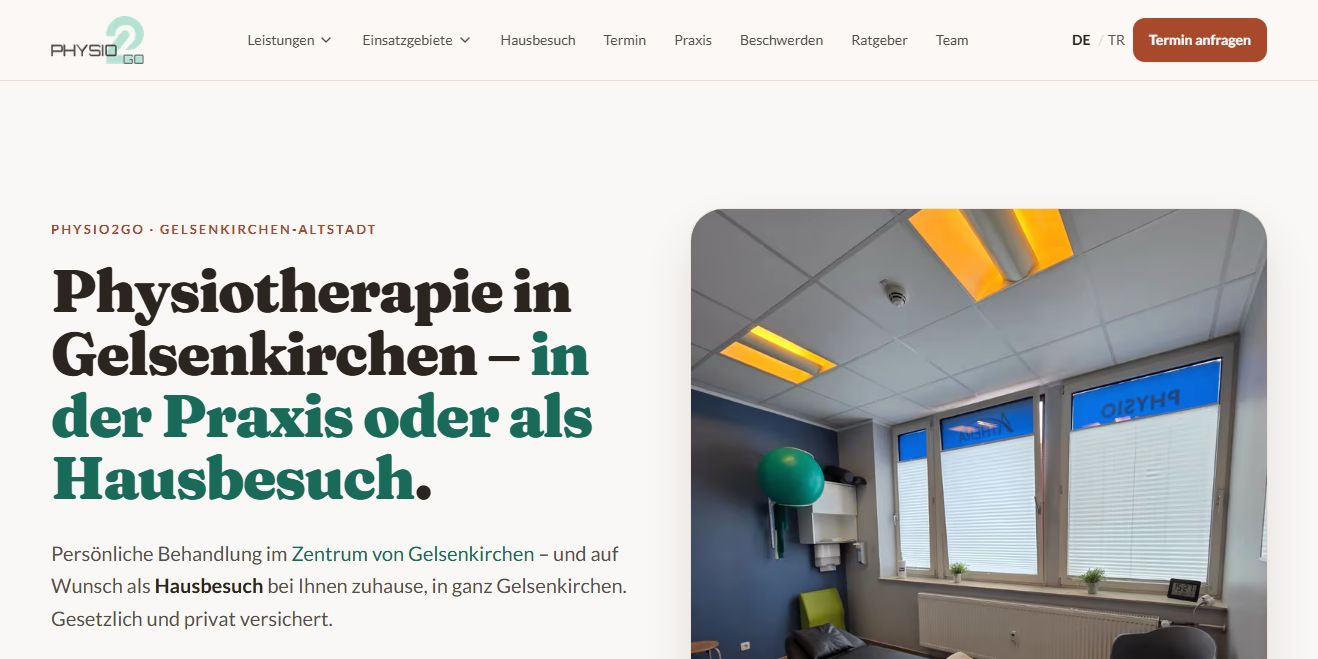
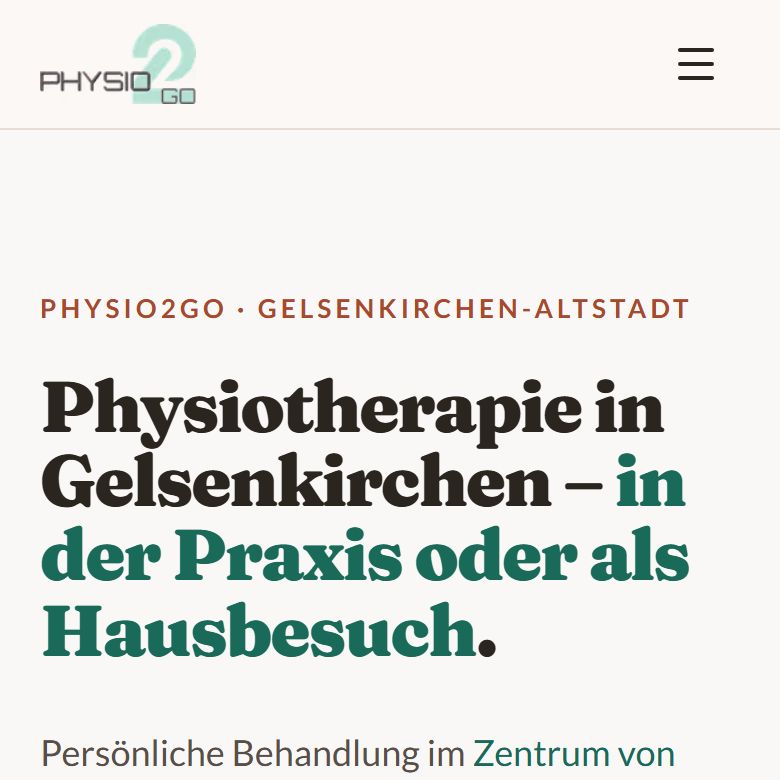
Pages for all 18 districts, in German and in Turkish, lead to an appointment request that arrives in the practice’s internal dashboard. Structured data tells search engines and AI assistants which practice this is. The images show public pages, captured on November 16, 2026.
Districts
The service-area overview groups the 18 districts into five boroughs, and each district has its own page for physiotherapy and home visits.
54 service-and-district pages, a third of the 162 possible
Website · Service areas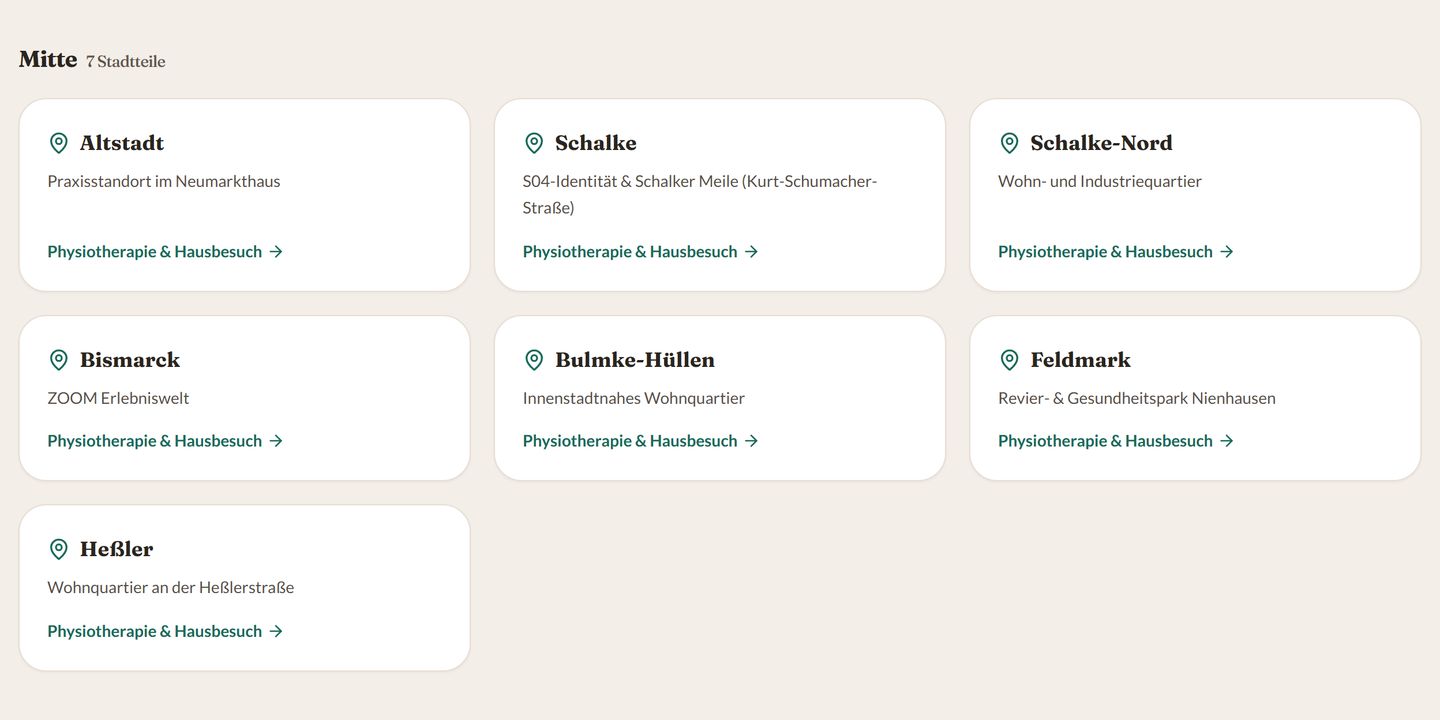
- The overview groups the 18 districts into five boroughs and gives the number of districts in each.
- Each tile describes its district in a few words; the tile for the old town (Altstadt) names the practice’s location.
- The link “Physiotherapie & Hausbesuch” (physiotherapy and home visits) leads to the district’s own page.
German and Turkish
Every content page exists in both languages, including the 29 guide articles; only the legal notice and privacy policy are German-only.
127 German and 125 Turkish pages in the sitemap, linked through hreflang
Website · Turkish home page on a smartphone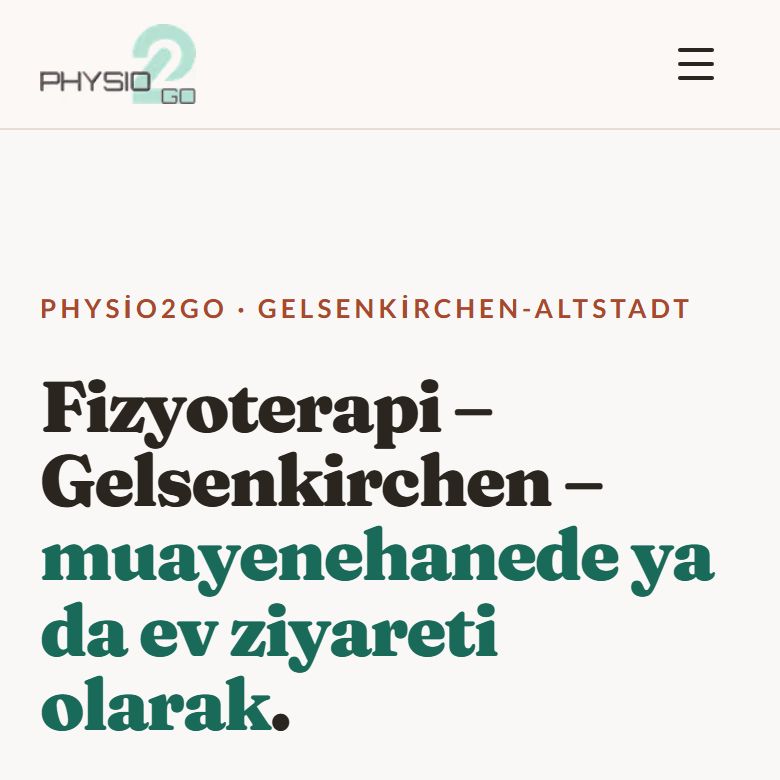
Page on physio-2go-neumarkthaus.de, captured on Nov 16, 2026 Clear identification
Structured data describes the practice with its full name, address, service area, hours, team and FAQs, plus an explicit note against mix-ups.
Wikidata links for 17 of 18 districts, 7 of 9 services and 15 of 19 conditions
- Practice
- full name, address, business hours, team and FAQs
- Service area
- 18 districts, with Wikidata IDs in llms-full.txt
- Note on mix-ups
- in the structured data, llms.txt and llms-full.txt
- Principles
- listed as publishingPrinciples in the practice’s data
- Crawlers
- robots.txt allows 17 named AI crawlers and control tokens
Appointment requests
Form requests reach an internal dashboard that requires a login, and a hidden field and a per-sender limit keep spam out without a CAPTCHA.
IP address not stored in plain text; dashboard and API blocked in robots.txt
- Form
- online appointment request without a third-party CAPTCHA service
- Spam protection
- hidden field and per-sender limit
- Privacy
- IP address not stored in plain text
- Dashboard
- internal area with a login for the practice team
How is the practice website structured?
On November 16, 2026, the XML sitemap listed 252 pages, 127 in German and 125 in Turkish. Per language, that includes nine service pages, 18 district pages, 54 service-and-district pages, 29 guide articles and other pages such as the glossary and the conditions overview.
Each guide article lists its sources and shows how current it is. Of the 139 sources in total, the most frequently cited are gesundheitsinformation.de from the Institute for Quality and Efficiency in Health Care (IQWiG) and gesund.bund.de, the Federal Ministry of Health’s portal. Next come German statutes, the Federal Joint Committee (G-BA), the National Association of Statutory Health Insurance Funds (GKV-Spitzenverband) and guidelines from the AWMF, the umbrella organization of German medical societies. A glossary with 36 technical terms and an overview of 19 conditions complete the section.
The practice is described in structured data with an explicit note to prevent mix-ups, and the llms.txt and llms-full.txt files summarize it with short answers. The robots.txt file allows search engines and named AI crawlers; an XML sitemap with change dates, an Atom feed for the guide section and IndexNow tell search engines about new pages. A dedicated “About this website” page (Über diese Website) explains the site’s development, technology, data protection and content principles in German and Turkish.
How does a request reach the dashboard?
According to the source code as of July 2, 2026, the form sends to an API that checks the hidden field and the per-sender limit, stores the request in PostgreSQL and emails the practice. The team sees requests in the dashboard after signing in. The pages themselves are generated ahead of time as finished HTML in German and Turkish.
- Website: German and Turkish
- Booking request: form
- Checks: limit per sender
- PostgreSQL: no plain-text IP
- Dashboard: sign-in required
Decisions
- Finished HTML in two languages Every page exists ahead of time as HTML, German at the main address and Turkish at /tr, linked for search engines through hreflang.
- A note against mix-ups Because a namesake practice operates in Gelsenkirchen, the structured data, llms.txt and llms-full.txt identify this practice explicitly.
- No CAPTCHA service A hidden field and a per-sender limit keep spam out, and the IP address isn’t stored in plain text.
- Third-party files only after consent Fonts and images are hosted on the site’s own domain, the route planner opens Google Maps only on click, and analytics load only with consent.
What was the starting point?
Physio2Go im Neumarkthaus is in Gelsenkirchen’s old town and offers physiotherapy at the practice and as home visits. The practice already had a website on the same domain, and we rebuilt it from the ground up.
The practice had to be unmistakable, and the site had to work in Turkish as well as German. There is at least one other practice called Physio2Go at a different address in Gelsenkirchen, so search engines and AI assistants had to recognize the practice in the Neumarkthaus unambiguously.
The brief covered planning, design and development, search engine optimization, preparing the site for AI assistants, online appointment requests and Google Search Console analysis, plus pages for all 18 districts. The practice team needed to see incoming requests in an internal dashboard.
How is the site built and tested?
The site is built with Next.js, React and TypeScript and generates every page ahead of time as HTML; requests are stored in PostgreSQL, hosted on Railway. The code as of July 2, 2026, includes a Playwright run through the public pages, the form and the dashboard; the live site may differ.
Layers
- User interfaces
- Website DE and TR: Next.js, prerendered HTML
- Appointment requests
- Dashboard with sign-in
- Core
- API for requests
- Spam checks without CAPTCHA
- Email notification
- Data
- PostgreSQL for requests
- schema.org structured data
- Operations
- Hosted on Railway
- XML sitemap, Atom feed and IndexNow
- Security headers such as HSTS
Properties
- Languages
- German at the main address, Turkish at /tr, linked through hreflang
- Third parties
- no files from third-party servers on page load without consent
- Map
- no embedded map; the route planner opens Google Maps only on click
- Analytics
- analytics load only with consent
- IP address
- not stored in plain text
- Security headers
- HSTS and further headers set
Quality
- The code as of July 2, 2026, includes a Playwright run that checks public pages for status and errors, the form through to the database and the sign-in to the request list.
- Every page is generated ahead of time; for the HTML pages fetched on November 16, 2026, the response header confirms this, and text and H1 are in the delivered HTML.
What can be verified?
As of November 16, 2026, the site is live in both languages. The XML sitemap lists 252 pages, including every one of the 18 district pages and all 29 guide articles in German and in Turkish; a recount on November 21, 2026, still found 252.
Measured · XML sitemap of the site, pages counted per language
We’ll publish measurements of rankings, clicks, requests and mentions in AI answers once they cover a meaningful period. We don’t publish figures about patients.
If your customers search in more than one language or another business has a similar name, we plan the languages and the distinction into the website from the start. Our AI visibility audit shows how you appear in AI answers today.
A website like this for your business
30 minutes, free. Reply within one business day (Mon–Fri).
Project facts
- Project
- New practice website in German and Turkish, with online appointment requests and a protected dashboard for incoming requests
- Client
- Physio2Go im Neumarkthaus, Gelsenkirchen, Germany
- Timeframe
- Project since June 2026
- Role
- Planning, design, development, SEO and GEO, Google Search Console analysis; the practice is responsible for the health content
- Technology
- Next.js with prerendered HTML, React, TypeScript, Tailwind CSS, PostgreSQL, hosted on Railway; hreflang, schema.org, llms.txt and llms-full.txt, IndexNow
- Status
- Live; no published results yet for search, requests or AI answers
- Verifiable
- Datafalke is named as developer in every page footer, the legal notice (Impressum) and on “About this website (external site),” which links to this case study.
Results depend on the starting point and do not transfer to every project. Published with the consent of Physio2Go im Neumarkthaus.
More case studies
Editorial note
Researched and drafted with AI assistance. Mohammad Alboush has not yet checked the sources, figures and claims.
Content not yet reviewed
Changes to this report
Show all 8 changes
| Date | Type | Change |
|---|---|---|
| First publication | Version 1: starting point, brief, solution and verified scope, without search or AI visibility figures yet | |
| Correction | Shortened the main heading. The statements remain the same. | |
| Correction | Removed the sentence on automated deletion of requests: the job exists in the code but does not run on the live site. | |
| Update | Version 2: added scope (252 pages), sources, privacy details and the link back from “About this website”; linked the structured data to the practice website’s identifiers | |
| Update | Added more views of the website: service areas and the Turkish home page. | |
| Update | Rebuilt as a website case study: added the modules, the architecture from form to dashboard and a technology section, and shortened the text. | |
| Update | Added a flow showing when a page for a service in a district goes live, based on the source code as of July 2, 2026. | |
| Correction | Cropped the districts screenshot for phones so its text is legible, and adjusted the markers. The statements remain the same. |
Spotted a mistake? Email us at kontakt@datafalke.de. We’ll fix it and log the change.